August Featured Webinar
Education, Resilience, and Hope


In this powerful webinar, Adiba Erfan shares her journey from Afghanistan to Australia and the story behind Pink Education Foundation. Hear how the organisation is creating education opportunities for girls in Afghanistan, the challenges faced by students and teachers, and how educators can contribute to supporting this important work.
Learn more about this webinar
This webinar shares the remarkable story of Adiba Erfan and the work of Pink Education Foundation, which is creating opportunities for girls in Afghanistan to continue learning despite severe restrictions on their access to education. Adiba reflects on her childhood, her determination to pursue education, and her journey into medical studies before the return of the Taliban brought her university education to an abrupt end.
After coming to Australia, Adiba established Pink Education Foundation, initially to support her younger sister and other girls who could no longer attend school. The initiative has since grown into a network of informal and underground learning opportunities, supported by educators in Afghanistan who continue teaching despite significant personal risk.
The webinar also gives voice to teachers and students involved in the program, who describe education as a source of hope, independence and future opportunity. Their experiences highlight both the risks involved and the determination of young women to keep learning.
The session concludes by exploring how educators can support Pink Education through volunteer teaching and help strengthen the English language program being delivered to girls in Afghanistan.
The NEAS Webinar Library
Missed it live? We pressed record. Replay expert-led webinars, pause for notes, rewind the good bits. Filter by theme and jump straight to what you need.
The NEAS Webinar Library brings together a curated collection of recorded professional learning sessions presented by NEAS, education specialists and industry partners. The collection offers practical ideas, expert perspectives, research, case studies and sector updates across English language teaching, assessment, leadership, quality assurance, digital learning, student support and international education.
Who Are These Webinars For
The webinar library is designed for professionals working across English language teaching and international education, including:
- teachers seeking practical classroom strategies and new approaches
- academic managers and emerging leaders
- assessment and test-preparation professionals
- quality assurance and compliance staff
- student support, administration and professional services teams
- education professionals seeking targeted development in areas relevant to their work
Time Commitment
Most webinars run for approximately 45–60 minutes, although duration varies according to the topic and format.
The collection includes:
- focused presentations
- practical demonstrations
- interviews and panel discussions
- research and industry updates
- provider case studies
Each webinar is a standalone resource, allowing participants to select topics relevant to their role, interests and professional-development goals. allows time for reflection and application between modules.
CPD Points
Log in to NEAS On-line to earn CPD Points. You will need to complete a short quiz on the Webinar to get your certificate and points. Points will automatically be added to your account.
What to Expect
The webinars have been recorded at different times and reflect a range of perspectives, presentation styles and professional contexts. Depending on the session, participants can expect:
- practical strategies that can be adapted to their workplace
- explanations of key concepts, frameworks and professional practices
- examples from English language providers and classrooms
- insights from researchers, regulators and industry specialists
- demonstrations of educational products, assessments and technologies
- discussion of emerging issues affecting English language education
Some webinars examine particular products, tests, regulations or sector developments. Information in these sessions reflects the position at the time of recording, and participants should consult current official sources where necessary.
What you will learn
Each webinar has a distinct focus, with its content outlined in the individual description. Across the collection, participants can:
- strengthen teaching, assessment and learner-support practices
- develop leadership and organisational capability
- build understanding of quality assurance and continuous improvement
- explore developments in AI, educational technology and online learning
- examine approaches to professional development and staff engagement
- deepen their knowledge of international education, student protection and regulatory practice
Participants can explore individual webinars or follow a topic area to build knowledge progressively.lined within the individual course descriptions below.
Log in to Watch
Some Webinars are free to watch without logging in to NEAS Online. These Webinars are shown in Orange.
To log into NEAS Online, you will need to either hold associate membership or work for a provider that holds Centre Membership..
The NEAS Webinar Library has been divided into the following sections. Click on each section to find webinars relevant to you.
Teacher and Learner Engagement
Engagement by Design: Active Learning in ELT
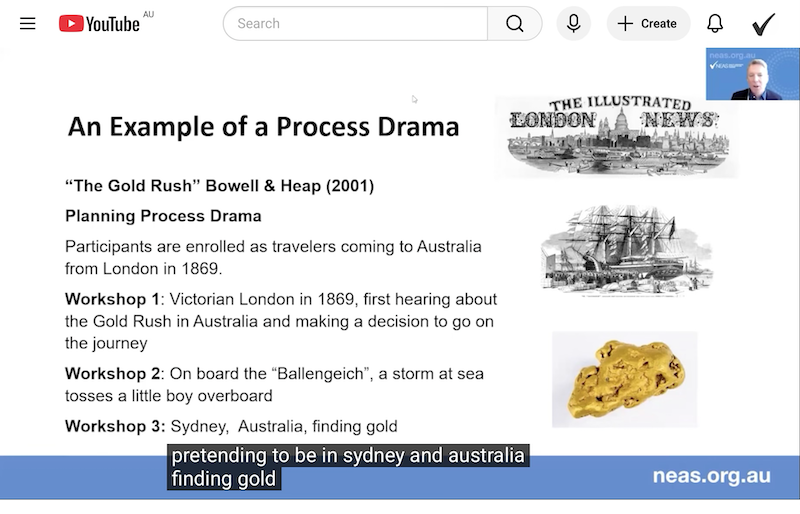
This webinar explores behavioural, cognitive, emotional and creative student engagement. It emphasises arts-based activities, particularly drama, to encourage experimentation, communication, empathy and deeper learning. Teachers can use scaffolded games, role-plays, simulations and process drama, adapting activities to proficiency levels while maintaining a safe, respectful environment with clear expectations for participation.
Learn more about this webinar
This webinar explores practical strategies for engaging English language learners through purposeful, creative and inclusive classroom experiences. It presents engagement as behavioural, cognitive and emotional, shaped by task design, enjoyment, social interaction and the learning context. Particular attention is given to arts-based pedagogy, which can connect language learning with learners’ memories and emotions, encourage experimentation and reduce anxiety about making mistakes.
The presenter demonstrates a progression from warm-ups, movement and language games to scripted role-plays, simulations, improvisation and process drama. Careful scaffolding enables teachers to begin with simple, controlled activities before introducing more demanding collaborative tasks. In process drama, teachers and students adopt roles within an unfolding story or shared problem, creating opportunities for active listening, sustained interaction, empathy and learner autonomy.
Research discussed during the webinar associates greater dramatic engagement with increased communication and deeper participation. Teachers also receive guidance on creating safe, respectful learning environments, establishing clear expectations and adapting activities for different proficiency levels, personalities and levels of confidence.
Future-Ready Learners: The Cambridge Life Competencies Framework
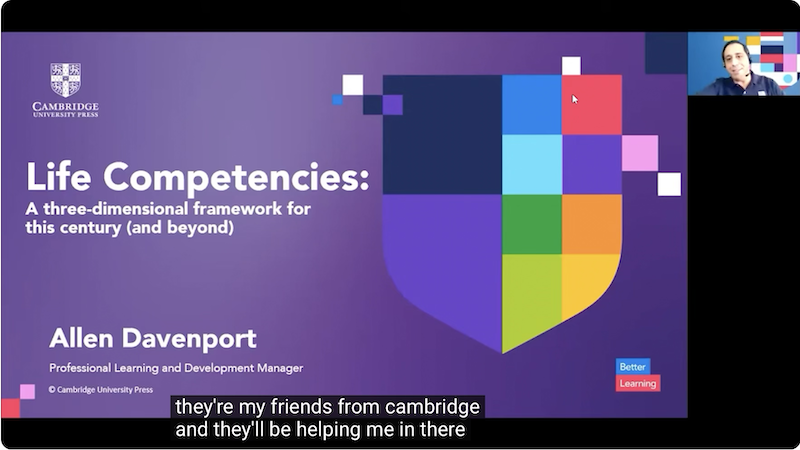
This webinar introduces Cambridge’s Life Competencies Framework, combining discipline knowledge, digital literacy and emotional development with creative and critical thinking, learning to learn, communication, collaboration and social responsibility. Teachers can integrate age-appropriate competency objectives into language lessons, provide feedback on development and begin with one competency before expanding their approach.
Learn more about this webinar
This webinar introduces Cambridge’s three-dimensional Life Competencies Framework, designed to help learners develop the capabilities required for changing social, educational and employment contexts while maintaining strong subject knowledge. The framework begins with three foundations: discipline knowledge, digital literacy and emotional development. Building on these foundations, it identifies six interconnected competencies: creative thinking, critical thinking, learning to learn, communication, collaboration and social responsibility.
Rather than presenting these competencies as broad labels, the framework divides each one into core areas, components and practical “can-do” statements that educators can use to plan and observe development. Its third dimension maps how competencies progress from pre-primary education through school, higher education and the workplace, recognising that expectations change with age and context.
Teachers learn how to embed competency objectives alongside language objectives, identify suitable target language and select activities such as debates, information gaps and graphic organisers. Feedback, self-assessment and peer assessment can address both language learning and competency development. Educators are encouraged to begin with one competency, observe learners’ progress, reflect on effectiveness and gradually extend their approach.
Beyond the 4Cs: Teaching 21st-Century Skills through ELT
This webinar encourages English programs to explicitly develop 21st-century skills alongside core language abilities. Beyond communication, collaboration, creativity and critical thinking, it highlights digital literacy, adaptability, self-regulation, citizenship and employability. These capabilities can be embedded through CEFR-aligned outcomes, inquiry, projects, real-world tasks, continuous needs analysis, frequent feedback and learner-centred assessment.
Learn more about this webinar
This webinar explores how English language programs can deliberately develop 21st-century capabilities alongside the core skills of reading, writing, listening and speaking. It presents these capabilities as dynamic, evolving in response to new technologies, changing workplace expectations, different uses of English and learners’ educational and professional pathways.
Beyond the traditional four Cs—communication, collaboration, creativity and critical thinking—the session considers engagement, self-regulation, digital and information literacy, adaptability, agility, leadership, motivation, metacognition, social responsibility, global citizenship and sustainability. Providers are shown how CEFR descriptors, graduate attributes and career-readiness frameworks can inform learning outcomes, classroom tasks, assessment criteria and rubrics.
Practical approaches include inquiry, task and project-based learning, arts-based activities, real-world problems, flipped learning and ongoing needs analysis. Assessment is presented as a continuous process supported by regular feedback, self-assessment and peer assessment, rather than a single final task. Teachers are encouraged to act as facilitators, giving learners greater ownership of their goals and progress. Making these capabilities explicit can strengthen course relevance, university preparation, employability and readiness for unpredictable social and professional contexts.
Confidence, Challenge and Progress: Learning Psychology through the GSE
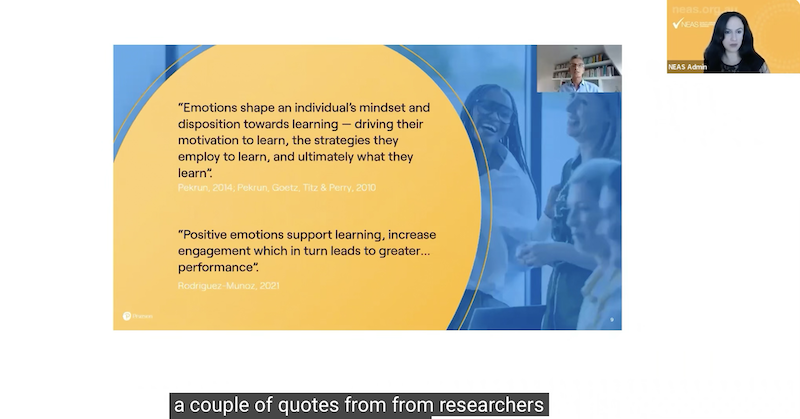
In this webinar, Mike Mayor, Senior Director, English Learning Research and Design at Pearson, explores the psychology of language learning and shares ways in which English teachers can use the Global Scale of English resources to set learners up for success and build the confidence that will support them on their life-long learning journey.
Learn more about this webinar
This webinar explores the relationship between confidence, motivation and progress in language learning, using Pearson’s Global Scale of English (GSE) as its central framework. Confidence is presented as a combination of optimism, resilience and belief in the possibility of success, while anxiety, embarrassment and frustration can contribute to disengagement.
The GSE extends the broad CEFR levels into a more detailed 10–90 scale, helping teachers and learners recognise incremental progress. It provides learning objectives for pre-primary, young, general, academic and professional learners, supported by teacher resources covering grammar, vocabulary and text analysis.
The presenter recommends placing learners at an appropriate level, working within their zone of proximal development and dividing larger outcomes into achievable, measurable steps. Sharing goals, providing appropriate scaffolding and recognising partial achievement can create experiences of success without removing productive challenge. Teachers are also encouraged to promote a growth mindset through reflection, constructive responses to mistakes, feedback and explicit connections between effort and progress. The session is presented through Pearson’s GSE and includes an overview of associated assessment tools and courseware.
Student-Centred ELT in Practice
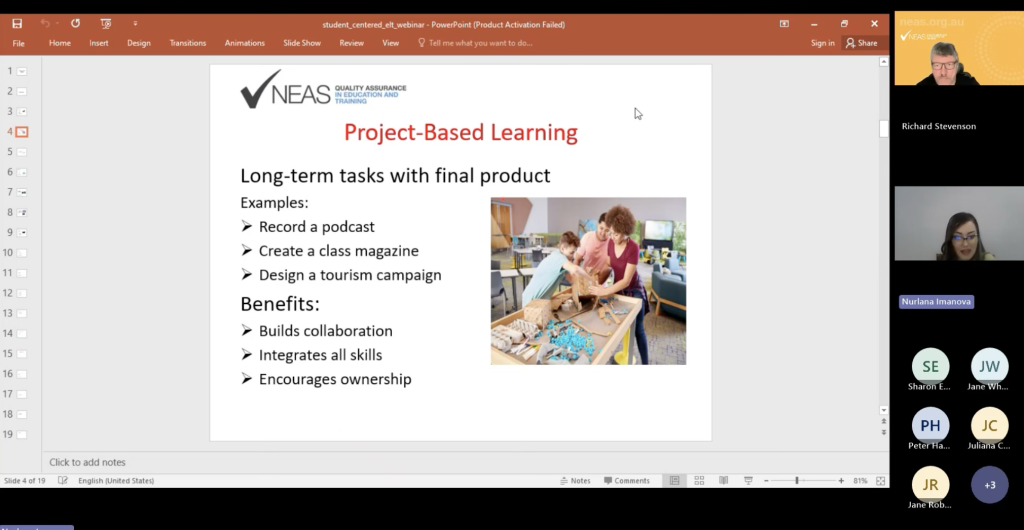
This webinar outlines student-centred ELT strategies including problem-based and project-based learning, flipped classrooms, inquiry, gamification, differentiation, peer teaching, reflection and technology. It encourages teachers to facilitate authentic communication and learner autonomy while aligning activities with clear objectives. The advice is practical but broad, with limited evidence or detailed implementation guidance.
Learn more about this webinar
This webinar introduces practical approaches to student-centred English language teaching and encourages teachers to shift from delivering content to facilitating active learning. It explores problem-based learning using real-world issues; project-based tasks such as podcasts, campaigns and class magazines; flipped classrooms supported by pre-class accountability; inquiry-based research; gamification; differentiated instruction; peer teaching; reflection; and technology-supported collaboration.
Across these approaches, the emphasis is on creating meaningful opportunities for learners to communicate, make decisions, investigate questions and take greater responsibility for their progress. Teachers are encouraged to scaffold participation with appropriate vocabulary and language support, adapt tasks for different proficiency levels and ensure that games and digital tools remain aligned with learning objectives.
Technology is presented as a means of extending learning beyond the classroom through quizzes, collaborative activities, feedback and progress tracking. Academic leaders are encouraged to support implementation through professional development, curriculum integration, innovation and aligned assessment. The session offers a broad collection of adaptable starting points, with the central message that small, purposeful changes can strengthen engagement, autonomy and participation.
Teaching Reading for Deeper Understanding
This webinar explores teaching reading through purposeful activities before, during and after each text. Strategies include surveying, prediction, think-aloud modelling, visualisation, comprehension checks, guided note-taking and critical reflection. Learners develop metacognitive awareness, recognise text organisation, connect ideas across readings and apply information, strengthening comprehension, academic literacy, confidence and learner independence.
Learn more about this webinar
This webinar presents a practical framework for teaching reading before, during and after learners engage with a text. Bonnie Cothren describes reading as an active process through which learners construct knowledge, make connections and develop new perspectives.
Before reading, teachers can activate prior knowledge and establish a clear purpose by using titles, images, topic sentences, text surveys, predictions and think-aloud modelling. During reading, paragraph-level questions, visualisation, retelling, guided notes and annotation help learners monitor comprehension, identify main ideas and recognise how a text is organised.
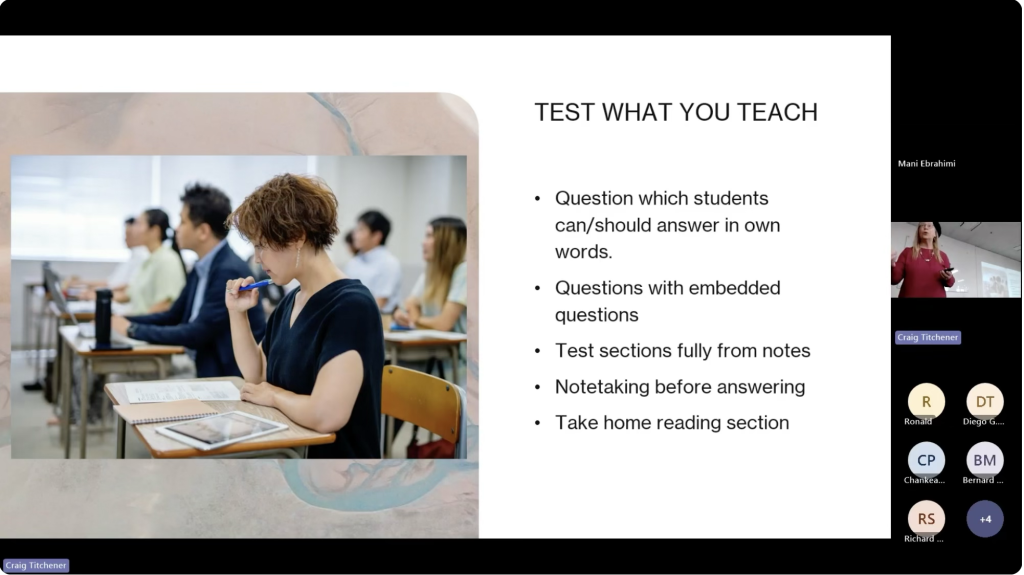
After reading, students can examine vocabulary, grammar, cohesion and argument; connect ideas across multiple texts; evaluate sources; and apply what they have learned to their own experiences and contexts. Assessment should reinforce these practices by examining learners’ use of surveying, note-taking and comprehension strategies rather than testing recall alone.
Throughout the session, the emphasis is on developing metacognitive awareness so learners can recognise confusion and select an appropriate response. Organising readings around sustained themes can also strengthen background knowledge, critical thinking, academic literacy and learner independence.
Arts in Action: Music, Drama and Creativity in ELT
Kit Perry and Andrea Pugh explore how music, drama, dance, visual art and digital creativity can enrich English teaching. Activities demonstrate ways to reinforce language, encourage participation, support learning and build confidence. Teachers learn to align tasks with curriculum objectives, include reluctant learners and adapt arts-based pedagogy for online delivery.
Learn more about this webinar
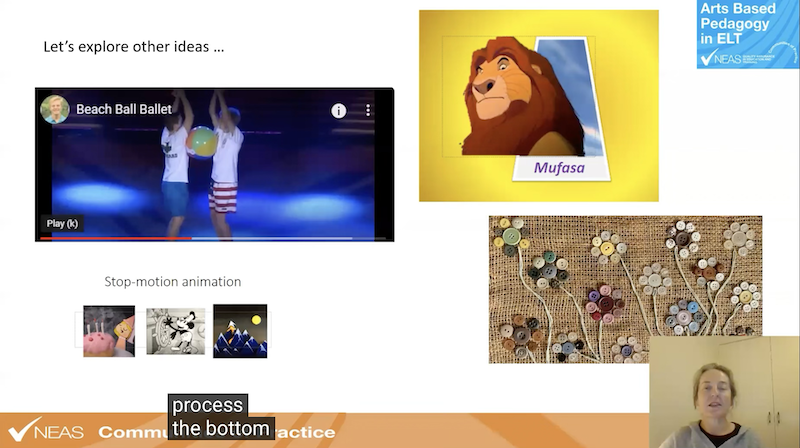
This Community of Practice webinar explores how music, drama, dance, visual art and digital creativity can enrich English language teaching. It combines practical classroom activities with broader guidance on using arts-based pedagogy to support purposeful language learning.
Kit Perry demonstrates ways to use songs to develop vocabulary, grammar, pronunciation, connected speech, listening and communication. Activities such as cloze tasks, word-grabbing games, movement and repeated routines can reinforce target language while helping learners participate with greater confidence. Andrea Pugh expands the discussion to creative pedagogy more broadly, showing how artistic tasks can encourage reflection, collaboration, critical thinking and meaningful language use.
The presenters consider how activities can be adapted for different proficiency levels, learning preferences and degrees of confidence, including reluctant or anxious participants. They emphasise creating a supportive environment in which experimentation feels safe and mistakes are treated as part of learning. The session also examines online applications involving digital tools, shared media and collaborative projects. Throughout, teachers are encouraged to connect creative activities with curriculum objectives so that music and art strengthen learning rather than functioning as disconnected entertainment.
Learning to Learn: Building Learner Autonomy
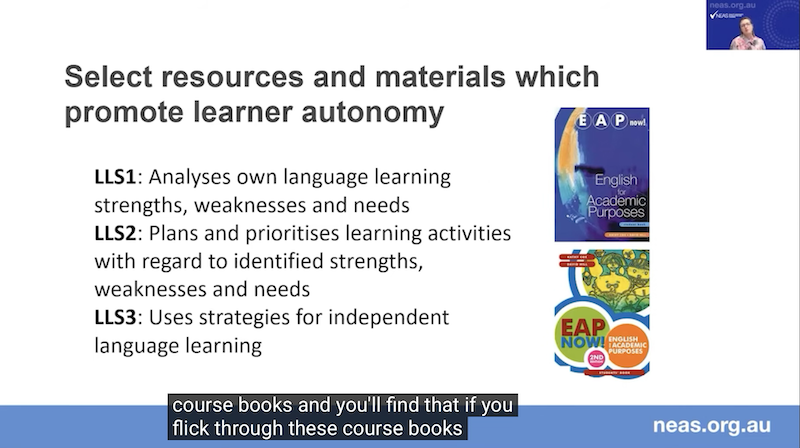
This webinar explores learner autonomy and practical ways teachers can help students take responsibility for their learning. Strategies include communicating learning outcomes, identifying goals and weaknesses, creating study plans, using reflective journals and incorporating structured self-assessment. Gradual introduction, clear criteria, regular guidance and feedback support engagement, independence and lifelong learning.
Learn more about this webinar
This webinar explores learner autonomy and practical ways English language teachers can help students take responsibility for their learning. It traces the concept from early self-access centres to contemporary approaches that emphasise motivation, self-regulation, reflection and active participation. The session explains how learner autonomy can be embedded through course design, student support and learning resources. Practical strategies include clearly communicating learning outcomes, inviting students to identify their goals and weaknesses, developing individual study plans, and incorporating structured self-assessment. Participants also discuss reflective journals, research projects, podcasts, learner-selected assessment tasks and collaborative activities. The webinar acknowledges that some students may initially resist autonomous learning or regard assessment as solely the teacher’s responsibility. It therefore recommends introducing autonomy gradually, explaining its purpose, providing clear criteria and maintaining regular teacher guidance and feedback. These approaches can strengthen student engagement, independence and the transferable learning skills required for further academic study and lifelong learning.
Drawn to Learn: Doodling for Focus, Creativity and Inclusion in ELT
This webinar explores doodling as a creative, inclusive tool for English language learning. It examines connections with concentration, memory, visual learning, metacognition and neurodivergent inclusion. Practical activities include visual note taking, vocabulary tasks, collaborative drawing and storytelling, encouraging teachers to transform spontaneous marks into purposeful opportunities for participation and expression.
Learn more about this webinar
Discover how doodling can become a purposeful tool for English language learning in this exploration of creativity, concentration and inclusive practice. The webinar traces doodling from ancient mark making to contemporary art and global education projects, examining why people doodle and how visual expression can support communication. It considers connections with constructivism, visual and kinaesthetic learning, mind mapping, metacognition and flow, while acknowledging that benefits vary between learners and contexts. Particular attention is given to neurodivergent students, for whom doodling may support focus, reduce anxiety and provide a reasonable classroom adjustment. Teachers are introduced to practical applications including visual note taking, vocabulary activities, collaborative drawing, storytelling, classroom displays and creative projects linked to language objectives. The session encourages educators to reconsider assumptions that doodling necessarily signals disengagement and to establish clear, inclusive expectations. Used thoughtfully, doodling can help learners process ideas, retain information, express themselves and participate with greater confidence.

Student Experience and Learning Pathways
Orientation That Works: Supporting Students from Pre-Arrival Onwards
This webinar presents student orientation as an ongoing process spanning pre-arrival, arrival and the entire course. Providers should deliver clear, accessible and interactive information about learning, support, safety, accommodation, employment and cultural adjustment. Staged activities, peer connections and feedback help maintain engagement, address changing needs and reduce confusion and risk.
Learn more about this webinar
This webinar presents student orientation as an ongoing process that begins before enrolment, continues when students arrive and extends throughout their course. Effective orientation establishes clear expectations, introduces course objectives and learning requirements, and connects students with the services and information they need to participate confidently.
Key areas include health and safety, accommodation, employment rights, student support and cultural adjustment. Information should be clear, accessible and appropriate for learners’ language levels, while staff and education agents need accurate, current guidance. Rather than delivering everything in a single information-heavy session, providers are encouraged to use smaller, staged and interactive activities. Suggested approaches include peer mentoring, weekly check-ins, virtual tours, comprehension quizzes, interviews and continued engagement with student handbooks.
Online orientation can incorporate breakout rooms, guest speakers, inquiry-based tasks and collaborative tools. Providers should also collect feedback from students, teachers and managers to evaluate and improve their approach. A well-designed orientation reduces confusion and risk, strengthens trust and belonging, and responds to students’ changing needs throughout their learning journey.
Supporting the Whole Student: Designing a Strong Student Experience
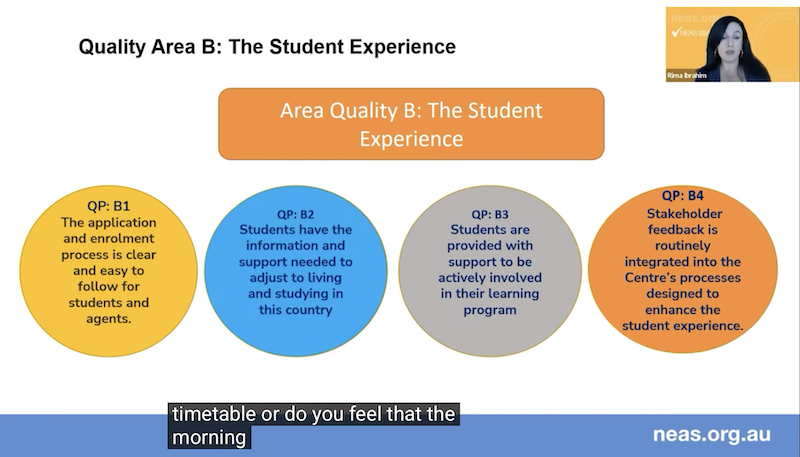
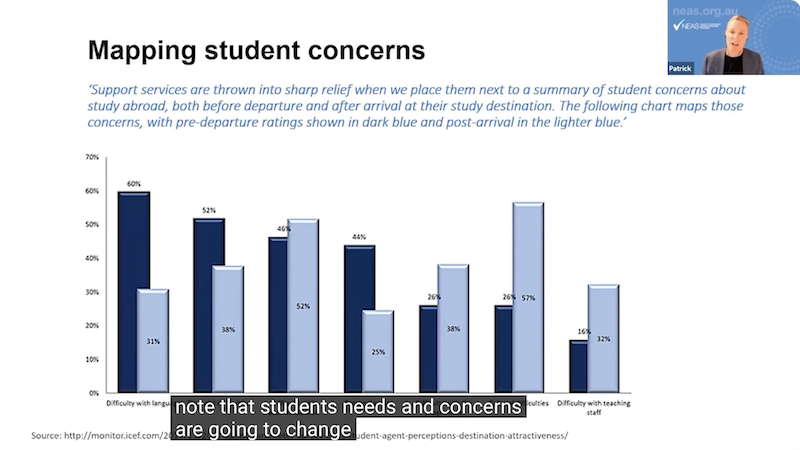
This webinar examines the international student experience from pre-arrival through study and beyond graduation. NEAS Quality Area B emphasises clear enrolment, effective orientation, accessible support, active learning and stakeholder feedback. Providers can strengthen belonging and success through information, equitable services, social activities, career guidance, responsive complaints processes and alumni engagement.
Learn more about this webinar
This webinar examines the international student experience as a continuing journey that begins before arrival, develops through orientation and study, and extends beyond graduation. NEAS Quality Area B provides the framework through four principles: clear application and enrolment processes; support for living and studying in Australia; assistance that enables active participation in learning; and systematic stakeholder feedback.
Before arrival, students need accessible information about accommodation, living costs, employment rights and available support. Orientation should then be inclusive, informative and engaging, covering course expectations, visa obligations, health and safety, critical incidents, legal assistance and everyday life in Australia. Student handbooks should be easy to find and understand, reinforced by staff and supplemented through FAQs, notices and digital communication.
Throughout their studies, learners should have equitable access to support, language-extension opportunities, career guidance and social activities that develop confidence, cultural awareness and belonging. Surveys, complaints, staff observations and agent feedback can guide improvement. Alumni networks, mentoring, employability workshops, celebrations and community activities can further strengthen students’ academic, social and professional experiences.
Successful School Pathways: Preparing EAL Students for Mainstream Study
This webinar examines how intensive English preparation supports international students entering primary and secondary schools. Drawing on John Paul International College’s experience, it covers explicit instruction, external benchmarking, personalised pathways, transition support and consistent exit standards. It also considers program resourcing, curriculum partnerships, teacher mentoring and measures of student success.
Learn more about this webinar
This webinar explores how intensive English preparation can support international students transitioning into primary and secondary schools. Drawing on experience at John Paul International College, David Ferguson defines success as more than achieving an English test score: it includes confident transition, mainstream academic performance, school completion, university entry and longer-term outcomes. He explains the ELICOS-in-schools model, in which students complete intensive preparation before entering mainstream classes, supported by explicit instruction, discrete development of reading, writing, speaking and listening, and management of cognitive load. Student progress is monitored through internal assessment, external benchmarking and mainstream results. Particular emphasis is placed on reading and writing readiness, consistent exit standards, personalised timetables for uneven skill profiles and sustained transition support. The session also considers primary-school preparation, staffing and resourcing, pathway partnerships, curriculum licensing, teacher mentoring and moderation. Schools are encouraged to select models that match their student numbers, capabilities and intended mainstream destinations.
When English Fades: Understanding and Addressing Language Attrition
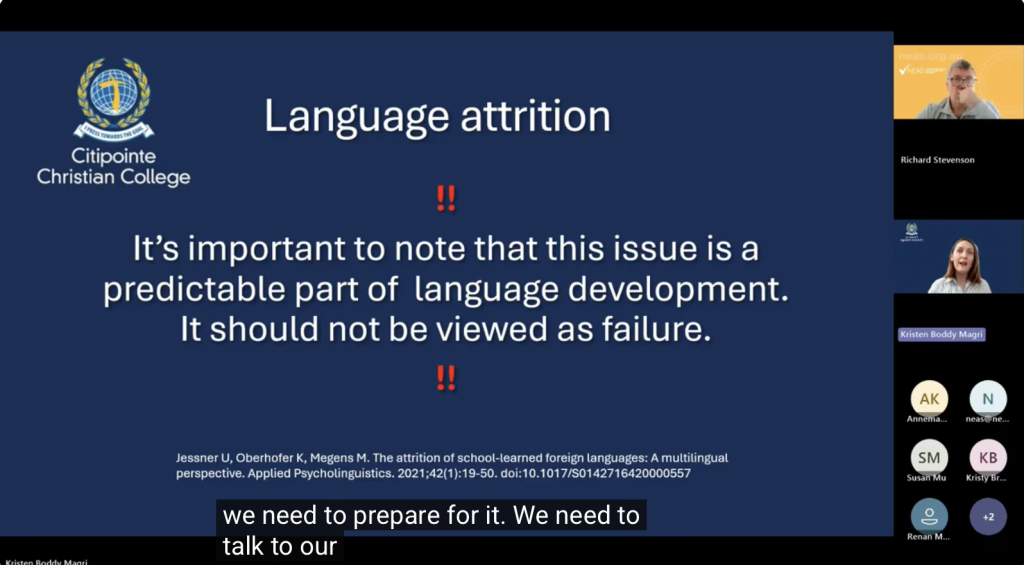
This webinar examines language attrition among EAL learners transitioning from intensive preparation into mainstream schooling. It identifies reduced practice, cognitive load, motivation, social change and loss of specialist support as contributing factors. Recommended responses include sustainable language habits, achievable goals, supportive connections, learner profiles, teacher development, scaffolding and cultural awareness.
Learn more about this webinar
This webinar explores language attrition among EAL learners after they move from intensive preparation programs into mainstream schooling. Kristen defines attrition as reduced or simplified language knowledge, or difficulty accessing previously learned language, and emphasises that it is a predictable part of development rather than evidence of failure. Drawing on observations from a Queensland secondary school, she identifies reduced language use, increased cognitive load, declining motivation, changed peer relationships and loss of specialist EAL support as contributing factors. Intermediate learners and productive skills may be particularly vulnerable during the transition. Recommended responses include building sustainable daily practice, maintaining productive language practice, setting achievable SMART goals, forming supportive English-speaking connections and creating learner profiles for mainstream teachers. Schools can also strengthen transition through EAL-informed professional development, visual scaffolding, clear classroom communication, cultural awareness and social activities. The session encourages shared responsibility among students, language specialists, mainstream teachers, school leaders and families.
Assessment and Learning Design
Assessing Beyond English
In this practical webinar, Ranita Gupta explores how assessment can better reveal what multilingual learners truly know and understand. Discover strategies for balancing formative and summative assessment, reducing language barriers, providing effective scaffolding, and designing more inclusive assessment practices that maintain academic expectations while making learning visible.
Learn more about this webinar
This webinar explores how educators can design assessment practices that more accurately reveal what multilingual learners know, understand and can do. Ranita Gupta examines the distinction between assessment for learning and assessment of learning, highlighting the importance of using both formative and summative approaches to build a more complete picture of student achievement.
A central focus of the session is the “double cognitive load” experienced by multilingual learners, who must demonstrate subject knowledge while simultaneously processing and producing language in English. Traditional assessment practices can therefore risk measuring English proficiency rather than the intended subject knowledge or conceptual understanding.
The webinar introduces practical strategies for creating more inclusive assessments without lowering academic expectations. These include adapting questioning techniques, using sentence frames and visual scaffolds, providing structured peer discussion and feedback, allowing additional processing time, breaking complex tasks into manageable stages, and incorporating multimodal ways for students to demonstrate understanding.
Ultimately, the session encourages educators to reconsider whether their assessments are truly making learning visible and to design assessment experiences that recognise both multilingual learners’ developing language proficiency and their academic capabilities..

Assessment for Learning: Evidence, Feedback and Better Decisions
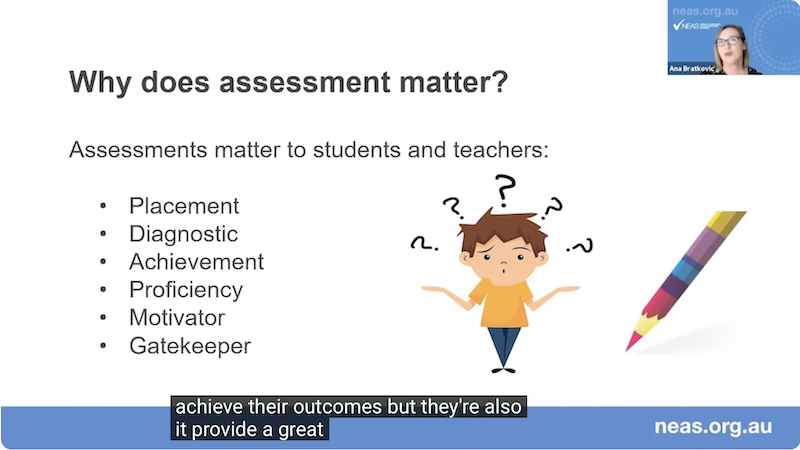
This webinar explains assessment as evidence used to judge learning outcomes, guide teaching and support decisions. It distinguishes formative and summative purposes, emphasises alignment, feedback and staff capability, and clarifies validation and moderation. Online delivery increased workload and integrity challenges, encouraging shorter, frequent assessments and item banks aligned with outcomes.
Learn more about this webinar
This webinar explains how assessment supports effective English language teaching and informed educational decision-making. Assessment involves collecting, analysing and interpreting evidence to determine whether learning outcomes have been achieved. It may be used for placement, diagnosis, progression, certification, motivation and high-stakes decisions, while also guiding teaching, learning and feedback.
The session distinguishes formative and summative assessment by purpose rather than task type. The same evidence may help learners improve, inform future teaching or formally record achievement. Assessment quality depends on alignment with intended learning outcomes and confidence that resulting decisions are valid, reliable, fair and meaningful. Providers are encouraged to develop a clear assessment framework, strengthen staff capability through targeted professional development and establish a constructive culture of assessment and feedback.
Validation examines the design, reliability, fairness, currency and flexibility of assessment tools, while moderation helps teachers apply criteria and standards consistently. The webinar also considers challenges associated with online delivery, including workload, academic integrity and technology. Recommended responses include shorter and more frequent assessment, avoiding unnecessary over-assessment, evaluating commercial tests carefully and developing assessment banks aligned with course outcomes.
How Automated Language Testing Works
This webinar explains how AI supports adaptive testing, automated speaking and writing assessment, and feedback. Machine scoring is trained and validated against human ratings, improving consistency and reducing routine marking. Used responsibly, AI can identify learner strengths and needs, connect results to learning objectives, and free teachers to support learning.
Learn more about this webinar
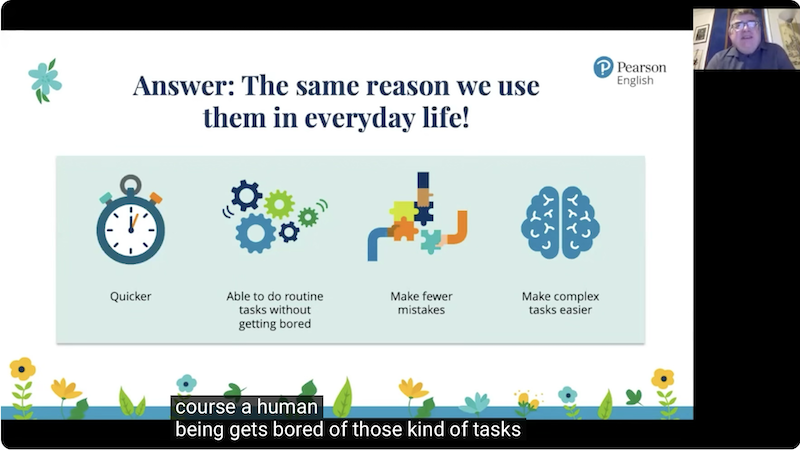
This webinar examines how artificial intelligence can support English language assessment and classroom learning. AI combines computing power, data and algorithms to enable adaptive testing, automated scoring and rapid analysis of learner performance. Pearson’s assessment systems provide the principal example, including machine scoring for speaking and writing that is trained against ratings from expert human examiners and validated before operational use.
Automated systems can process selected language features consistently and without fatigue, although important limitations remain, particularly when evaluating higher-order performance, meaning and context-dependent language use. Computer-based assessment can also combine language skills and generate more detailed performance information than many traditional paper-based tests.
The webinar highlights the value of connecting assessment results with calibrated learning objectives, targeted activities and progress reporting. This can help teachers identify learner strengths, gaps and appropriate next steps. AI is presented as a complement to professional judgement rather than a replacement for teachers, reducing routine marking while allowing educators to focus on motivation, relationships and learning support. Future development should prioritise authentic contexts, useful feedback, fairness, transparency and evidence-based measurement.
Assessment That Empowers: Validity, Washback and Learner Confidence
This webinar explains assessment as evidence used to guide decisions and improve learning. It examines validity, reliability, practicality, impact and positive washback, emphasising alignment between instruction and examination demands. Integrated assessment can strengthen proficiency, confidence and motivation. The second half promotes Cambridge English qualifications and their recognition for global mobility.
Learn more about this webinar
This webinar explores how assessment can support language learning, demonstrate achievement and inform educational decisions, using Cambridge English qualifications as a central example. Assessment is defined as evidence collected to guide decisions and may include both informal classroom practices and formal examinations. Formal assessment can be direct or indirect, norm- or criterion-referenced, and designed for a single level or multiple proficiency levels.
Four core principles are examined: validity, meaning that score interpretations are appropriate for their intended purpose; reliability, referring to the consistency of results; practicality, including time, cost and administration; and impact, covering the effects of assessment on learners, teachers and instruction.
The session also examines positive washback, which occurs when teaching activities, learning objectives and examination demands are aligned. Tests should assess intended abilities directly, sample content broadly, use clear criteria and make their formats transparent. Integrated teaching and assessment can support proficiency, confidence, motivation, critical thinking, self-regulation and effective feedback. The second half focuses on Cambridge English qualifications and their recognition for study, employment, visa and migration purposes across different countries.
Beyond Placement: Using IDAT Diagnostics to Guide Learning
This webinar explains how existing assessments can diagnose individual strengths, gaps and support needs, rather than simply place learners. Results should inform learner profiles, goals, scaffolding, targeted work and transitions between teachers. IDAT provides the main example, particularly for school-aged students, although the principles can be applied to providers’ tests.
Learn more about this webinar
This webinar argues that assessment should do more than place learners at a particular level. Assessment evidence can also identify individual strengths, gaps and support needs, helping teachers determine appropriate next steps and plan future learning.
Heidi Reid presents learning as a developmental continuum, with assessment used to monitor individual growth rather than simply compare students. Providers are encouraged to analyse what learners have achieved, what they are currently working towards and what they have yet to demonstrate. Results should be accessible to teachers and transferred between classes so that support remains consistent when students change levels or instructors. Practical applications include learner profiles, individual learning plans, student-generated goals, lesson scaffolding, targeted homework and differentiated support.
IDAT provides the principal example of a broader diagnostic profile, particularly for school-aged learners. It covers language, mathematics, science, technology, aptitude, character and learning preferences. However, providers do not necessarily need a new assessment system: existing tests can become more diagnostically useful when questions are grouped around learning outcomes and the resulting evidence is analysed systematically. The session also introduces associated IDAT and NEAS activities.
English Tests and Exam Preparation
Turning IELTS Research into Better Preparation
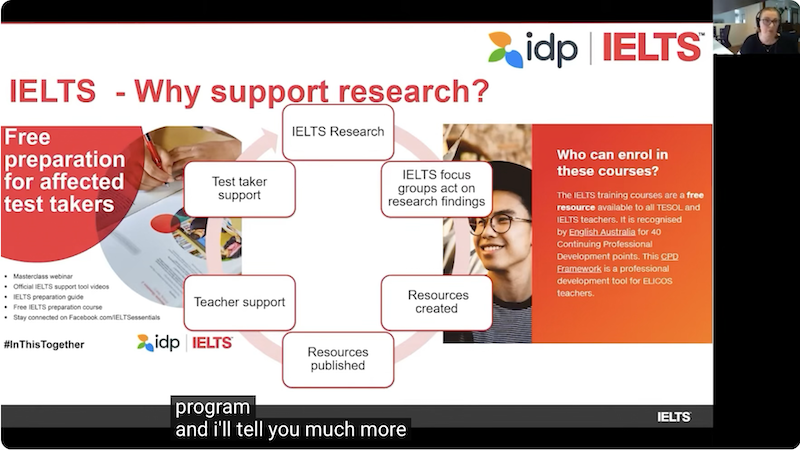
This webinar shows how IELTS research led to teacher training and preparation resources addressing inconsistent teaching, limited assessment literacy, ineffective strategies and online misinformation. It introduces articles, videos, practice materials and IELTS Progress Check feedback. Teachers gain understanding of band descriptors, speaking and writing criteria, common errors and test preparation.
Learn more about this webinar
This webinar examines how IELTS research has informed the development of resources for effective test preparation. Studies of preparation practices identified considerable variation between classrooms, limited assessment literacy among some teachers and concerns that speaking and writing judgements were subjective. Test takers also reported inadequate preparation, ineffective strategies and reliance on online misinformation or memorised formulas.
In response, IELTS developed its Teacher Training Program to strengthen teachers’ understanding of test content, assessment terminology, public band descriptors and the features that influence spoken and written performance. The session also introduces official articles, videos, practice materials and webinars, together with the paid IELTS Progress Check, which provides individual feedback not available through the live test.
Practical examples address speaking performance, approaches to True/False/Not Given questions and common writing difficulties. These include weak paragraphing, incorrect formats, partially answered prompts, unclear positions and excessive reliance on memorised language. Teachers are encouraged to use reliable official resources, examine their own classroom practices through action research and explore grants or awards that support further professional development in IELTS preparation.
Inside the Duolingo English Test: AI, Adaptivity and Security
This session is facilitated by the Head of Security and the Head of Assessment Communication for the Duolingo English Test and provides an in-depth and comprehensive insight into the test design, validity and security.
Learn more about this webinar
This webinar introduces the Duolingo English Test following its endorsement under NEAS Quality Area K and examines how artificial intelligence supports its design, delivery and security. Duolingo presents the assessment as an accessible online alternative to examinations delivered through physical test centres.
Generative AI is used to produce reading passages, conversations, distractors, listening audio and other item content. Human reviewers then examine quality, fairness and potential bias before items are piloted and added to a bank containing more than 10,000 questions. Computer-adaptive technology estimates each test taker’s proficiency and selects appropriately challenging items, allowing the test to be shorter while improving measurement efficiency and limiting repeated exposure to individual questions.
The session states that responsible-AI standards address validity, reliability, fairness, privacy, security, accountability and transparency. Security measures include a controlled desktop application, identity and biometric checks, digital-forensics data, plagiarism detection and recorded video review. AI flags potential irregularities, while anonymous human proctors make final decisions and escalate complex cases. The webinar also explains result certification, retesting and appeal processes.
IELTS 2023: Band Descriptors and One Skill Retake
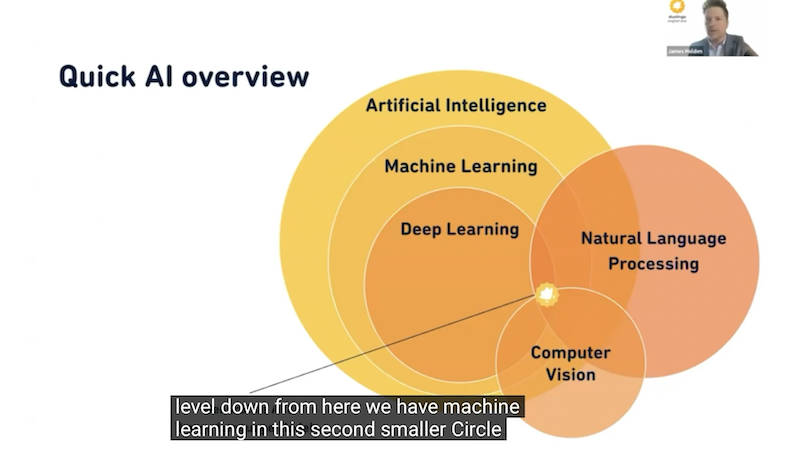
This webinar presents three IELTS developments: public speaking and writing band descriptors, teacher-training resources, and One Skill Retake. It explains assessment criteria, teacher courses, retake eligibility, revised result reports, security and verification.
Learn more about this webinar
This webinar presents three IELTS developments: publicly available speaking and writing band descriptors, professional-development opportunities for teachers, and IELTS One Skill Retake.
The band descriptors show how examiners assess task achievement or task response, coherence and cohesion, vocabulary, grammar, fluency and pronunciation. Teachers can use them to distinguish between performance levels, identify specific areas for improvement and provide more targeted feedback. The session also introduces IDP’s self-paced speaking and writing courses, workshops, familiarisation sessions, quizzes and certificates for IELTS teachers.
IELTS One Skill Retake allows eligible candidates to repeat one test component following an original computer-based test. The resulting report identifies the retaken skill while retaining information about the original test. Presenters describe this as greater flexibility for candidates whose performance in one component may not reflect their broader ability, without changing the required standard. The webinar also covers identity checks, result validation, institutional verification and security processes. Organisations remain responsible for deciding whether to accept retaken results and registering to receive them. Overall, the session combines practical assessment guidance with an overview of IELTS services and resources.
Cambridge Exam Preparation That Engages
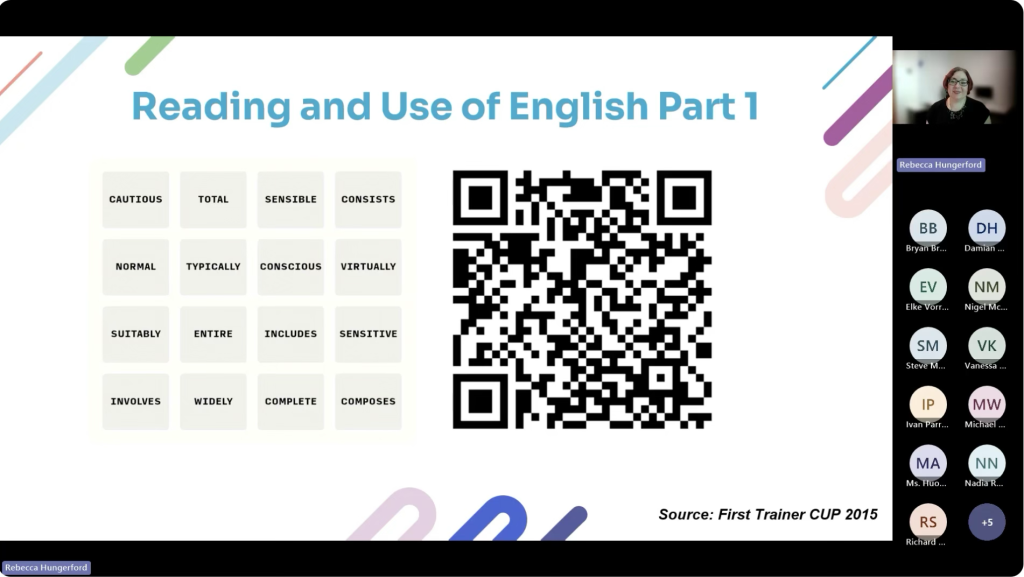
This webinar presents engaging classroom activities for Cambridge B2–C2 Reading and Use of English preparation. Running dictations, word games, Battleships, team challenges and jigsaw tasks encourage collaboration, movement and discussion. Students examine grammar, vocabulary, cohesion and paraphrase while developing effective, transferable exam strategies and understanding how correct answers are reached.
Learn more about this webinar
This webinar explores ways to make Cambridge B2–C2 Reading and Use of English exam preparation more interactive and engaging. Rebecca Hungerford identifies a classroom cycle in which students complete tasks, check answers and move on without examining the language or strategies involved. She demonstrates adaptable, low-preparation activities that encourage collaboration, movement, discussion and analysis. Examples include running dictations, word-sorting and Connections games for multiple-choice cloze tasks; a Battleships activity for open cloze; identifying incorrect words; rotating team challenges and keyword mix-ups for sentence transformations; jigsaw discussions for cross-text matching; and paired reconstruction of gapped texts. The activities help learners notice word classes, collocations, function words, grammar, cohesion, paraphrase, agreement and contrasting viewpoints. They also promote peer learning, strategic thinking and reuse of vocabulary in new contexts. The session emphasises that reaching an answer quickly is not always the main goal: examining how answers are reached develops language and examination skills.
TOEFL iBT 2026: What’s Changing and Why
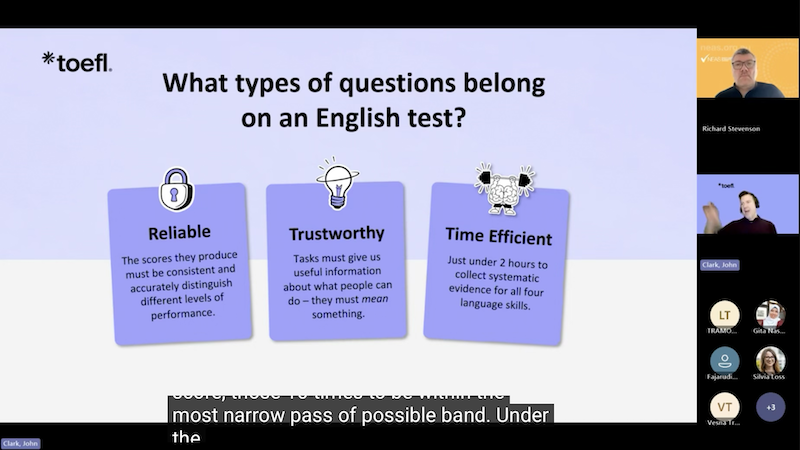
This webinar explains the redesigned 2026 TOEFL iBT, including adaptive Reading and Listening sections, updated academic communication tasks, faster results and a CEFR-aligned 1–6 score scale. It also outlines Australia’s interim 0–120 version for visa purposes and enhanced Home Edition security through live proctoring, automated monitoring and strengthened identity checks.
Learn more about this webinar
This webinar outlines updates to the 2026 TOEFL iBT and explains the research underpinning its redesigned format. ETS introduces multistage adaptivity in Reading and Listening, adjusting difficulty midway to provide an efficient and tailored assessment. New tasks reflect academic communication, including listening to conversations, contributing to an academic discussion and responding to a structured interview. The revised score scale runs from 1 to 6 in half-band increments, aligns more directly with CEFR levels and averages the four section scores. Results are now delivered within three days. The webinar also explains Australia’s interim arrangements: TOEFL iBT Australia retains the previous 0–120 scale for visa purposes while approval for the revised version is pursued. Home Edition improvements include streamlined registration, a single testing application, live ETS proctors, automated monitoring, a second camera and strengthened identity checks. Throughout, the presenter highlights validity, reliability, score interpretation, security and considerations for institutions and test takers.
AI, Psychometrics and the Future of Language Testing
Dr Alina von Davier discusses how psychometrics, adaptive testing and responsible AI are transforming language assessment. Using the Duolingo English Test as an example, she explores accessibility, multimodal tasks, automated item generation and test security, while emphasising human oversight, fairness, validity, bias detection and ethical decision-making in high-stakes assessment contexts..
Learn more about this webinar
This fireside conversation with Dr Alina von Davier, Chief of Assessment at Duolingo, examines how psychometrics, machine learning and responsible AI are reshaping language testing. Drawing on her extensive career, von Davier explains how adaptive testing can improve accessibility, efficiency and score precision. She describes the Duolingo English Test’s digital delivery, integrated multimodal tasks and use of AI to generate item banks, while emphasising that human experts remain essential for design, review, bias detection and quality control. The discussion explores Duolingo’s Responsible AI Standards, which connect transparency, accountability and fairness with principles of validity, reliability, comparability, privacy and security. It also considers accent diversity, differential item functioning, authentic assessment, test-taker anxiety and the ethical responsibility to avoid harm in high-stakes decisions. The session concludes with questions about critical thinking, item quality, test length, institutional acceptance and suitability for learners, highlighting the collaboration required between assessment specialists, language experts and engineers.

IELTS Writing Task 2: From Question to Finished Essay

Dr Nurlana Imanova presents strategies for improving IELTS Academic Writing Task 2 performance. The webinar explains the four assessment criteria and guides candidates through analysing questions, planning ideas, structuring essays, developing paragraphs and managing time. It emphasises relevant arguments, clear organisation, natural vocabulary, accurate grammar, effective paraphrasing and careful checking.
Learn more about this webinar
This webinar focuses on helping IELTS candidates improve performance in Academic Writing Task 2 and work towards Band 7. Dr Nurlana Imanova explains the four assessment criteria—Task Response, Coherence and Cohesion, Lexical Resource, and Grammatical Range and Accuracy—and shows how each influences the score. Participants learn strategies for analysing questions, identifying the topic and specific focus, brainstorming ideas, and planning an essay efficiently. The session outlines a structure for introductions, thesis statements, body paragraphs and conclusions, supported by model sentences and a high-scoring sample response. It also examines topic sentences, supporting evidence, paragraph development, linking devices, collocations, paraphrasing and complex sentence forms. Throughout, accuracy, clarity and natural language are prioritised over unnecessarily advanced vocabulary or complicated grammar. The webinar concludes with guidance on avoiding common errors, maintaining an appropriate academic register and managing the forty-minute task through five minutes of planning, thirty minutes of writing and five minutes of checking.
Generative AI for IELTS: Prompting, Materials and Feedback
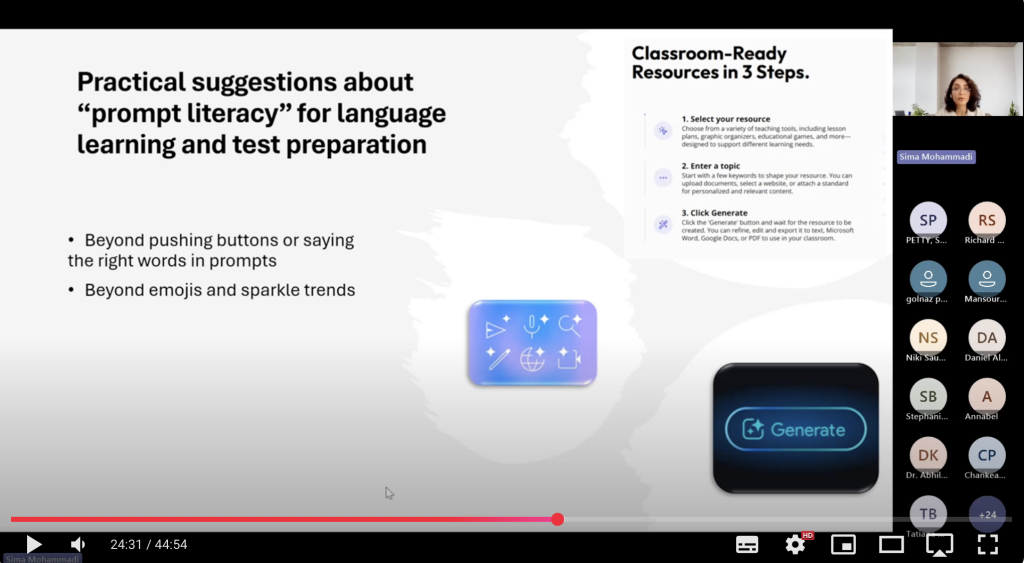
Sema Mohammadi examines how generative AI and prompt literacy can support IELTS preparation, language teaching and assessment. Drawing on research with teachers and students, she demonstrates techniques for generating materials, activities and feedback while addressing hallucinations, bias and unreliable judgement. Teachers remain responsible for contextualising, evaluating and refining AI-generated output.
Learn more about this webinar
This research-focused webinar examines how generative AI can support IELTS preparation, language teaching and assessment while preserving the role of professional judgement. Drawing on a literature review and fieldwork with students and teachers, Sema Mohammadi explores how people communicate with AI through natural-language prompts. She explains input-output, few-shot, chain-of-thought and progressive-hint prompting, showing how prompts can generate texts, listening materials, test items, lesson activities and preliminary assessment feedback. The session also considers limitations, including hallucinations, inconsistent scoring, cultural and linguistic bias, weak qualitative judgement and difficulty evaluating deeper reasoning. Practical guidance emphasises contextualising prompts for particular learners, embedding pedagogical knowledge, supplying criteria and examples, and refining outputs iteratively. Rather than accepting generated material at face value, teachers are encouraged to evaluate its accuracy, appropriateness and usefulness. The webinar presents AI as a collaborative tool for planning, reflection and materials development, with teacher expertise remaining essential to responsible and effective use.
Inside TOEFL iBT: Design, Scoring and Global Recognition
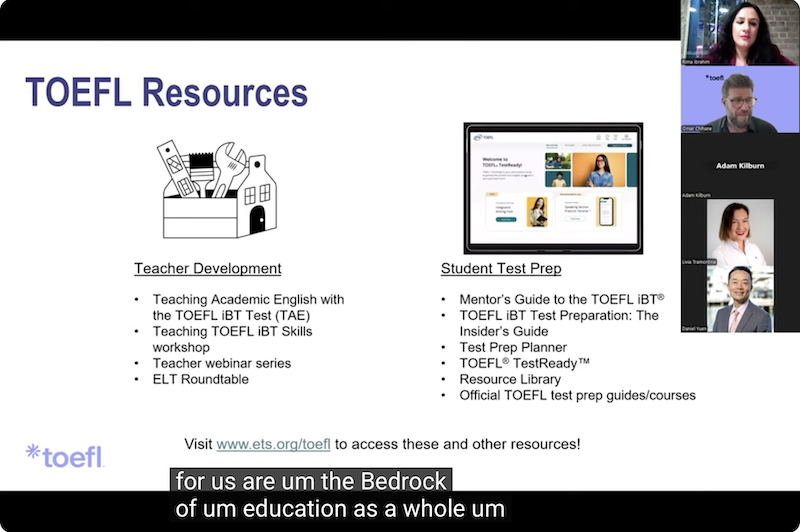
This webinar introduces the TOEFL iBT’s history, recognition and approach to assessing academic English. Omar Chihane discusses accessibility, test design, score reporting, preparation resources and the combined use of human and automated scoring. The session also explores global student mobility, institutional decision-making and the role of teachers in student preparation.
Learn more about this webinar
This webinar introduces the TOEFL iBT, covering the test’s history, recognition and approach to assessment. The presentation explains how TOEFL evaluates reading, listening, speaking and writing for academic study, supported by ETS research, technology and security systems. Presenter Omar Chihane discusses efforts to improve accessibility, simplify registration, shorten the testing experience, accelerate score reporting and strengthen preparation resources. Emphasis is placed on balancing automated scoring with human review, maintaining score validity and using assessment data to support institutional decision-making. The discussion considers global student mobility, competition among English proficiency tests and TOEFL’s positioning beyond the United States. Teachers are presented as central partners in helping students prepare effectively, informing resource development and strengthening access to international education. Questions address institutional relationships, communicative competence, cultural context and the continuing role of human expertise. Overall, the session presents TOEFL’s strategy at the time for modernising assessment while retaining research-based quality and rigour.
TOEFL Essentials: Setting Scores and Interpreting Performance
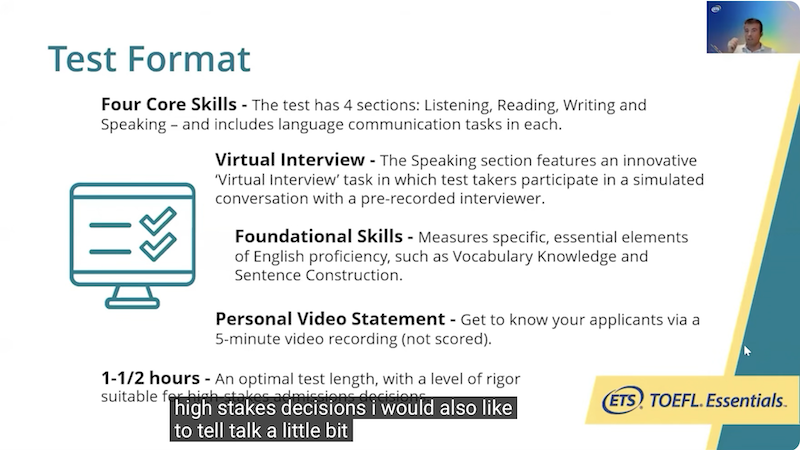
This webinar introduces TOEFL Essentials, examining its research, adaptive design, scoring and remote delivery. ETS representatives explain its four-skills format, academic and general content, score concordance with TOEFL iBT and CEFR, institutional score-setting guidance, supporting performance evidence and remote testing security, including human proctoring, identity checks and session monitoring procedures.
Learn more about this webinar
This webinar introduces TOEFL Essentials and the research supporting its design, scoring and remote delivery. Representatives from ETS explain how the test assesses reading, listening, writing and speaking across academic and general contexts through fast-paced tasks. Its multistage adaptive approach adjusts task difficulty according to performance, enabling a shorter testing experience while maintaining measurement accuracy across proficiency levels. The session outlines the 1–12 band scale, section scores, foundational skills indicators and concordance with TOEFL iBT scores and the Common European Framework of Reference. Guidance is provided for institutions setting overall and skill-specific requirements. The presenters also describe evidence available to score users, including speaking and writing samples and a personal video statement. Remote testing security measures include identity and environmental checks, human proctoring, facial recognition, gaze tracking and recorded sessions. The webinar concludes by comparing TOEFL Essentials with TOEFL iBT and explaining how institutions can interpret scores for admissions decisions.
Digital Learning, AI and Data
Online ELT That Works: Access, Interaction and Feedback
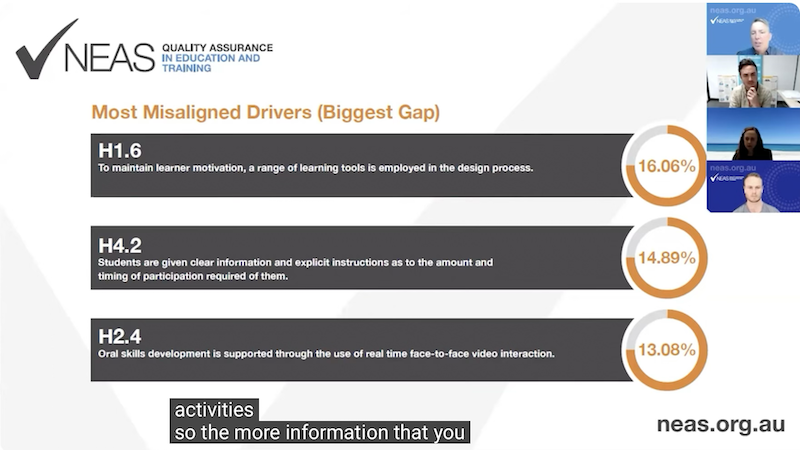
The masterclass outlines quality online English language delivery, emphasising accessible design, scaffolded assessment, reliable technology, clear communication and live speaking practice. Research identified strengths in technology and peer assessment but gaps in motivation, workload clarity and oral interaction. Effective programs combine varied activities, social connection, timely feedback and teacher involvement.
Learn more about this webinar
This masterclass examines effective online delivery for English language teaching and the quality standards needed to support a positive learner experience. Strong online programs require intuitive and accessible design, varied and transparent assessment, reliable technology, responsive learner support, and integrated systems for orientation, communication and progress reporting.
Online content should be organised into manageable sections with clear instructions, appropriate scaffolding and inclusive materials. Automated feedback can support learning where suitable, but students also need regular opportunities to develop speaking skills through live interaction. Research comparing teacher and student perspectives identified strengths in technology use, self-assessment and peer assessment, while revealing gaps in learner motivation, workload expectations and oral communication practice.
Practical strategies include varying digital tools and task types, encouraging meaningful interaction, creating social learning opportunities and using breakout rooms, guest speakers, gamification and problem-solving activities. Presenters emphasise that successful online teaching requires careful preparation, suitable resources and confidence with technology. Although online learning can offer flexibility, scale, personalisation and detailed reporting, teachers remain essential for sustaining motivation, encouraging participation, providing feedback and building connection.
From Data to Decisions: Building a Smarter Education Provider
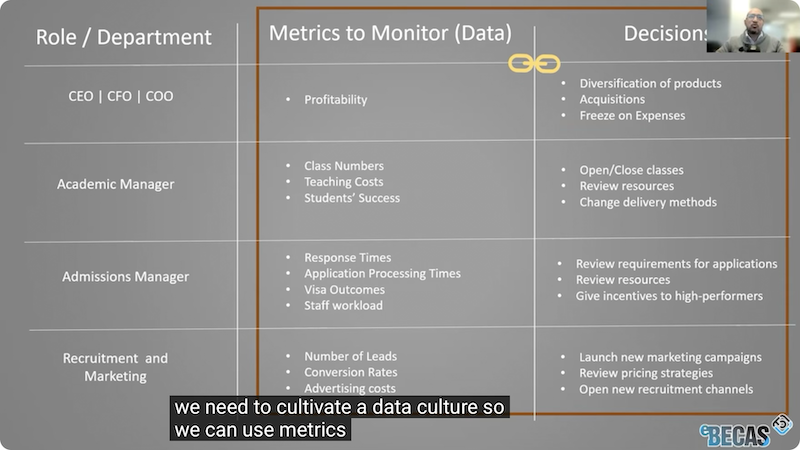
This webinar explains how education providers can build a data culture to support informed decisions. It outlines organisational maturity stages, common reporting challenges and the value of trusted, accessible information. Demonstrations of eBECAS and Power BI show how automated dashboards can track enrolments, conversions, sales, commissions and cash flow accurately.
Learn more about this webinar
This webinar explains how education providers can use data to make timely, informed and strategic decisions. It shows how leaders, academic managers, admissions teams and marketing staff can monitor profitability, student success, processing times, workloads, leads, conversions and advertising costs. The presenter defines data culture as organisational behaviours supported by trusted information, analytics and technology rather than opinion, undocumented knowledge or intuition. Institutions progress through five maturity stages: initial, repeatable, defined, capable and efficient. Common obstacles include cost, reporting time, manual errors, limited accessibility, privacy concerns, inconsistent reports and weak data literacy. Automated connections between student management systems and business-intelligence platforms can improve accuracy, frequency, accessibility and trust. Using eBECAS and Microsoft Power BI, the webinar demonstrates dashboards tracking enrolments, offers, conversion rates, commissions, sales targets and cash flow, along with automatic refreshes, alerts and natural-language queries. However, sustainable improvement requires organisation-wide participation, staff development and leadership from senior executives.
Build Better Language Tests with AI: A Practical Tutorial
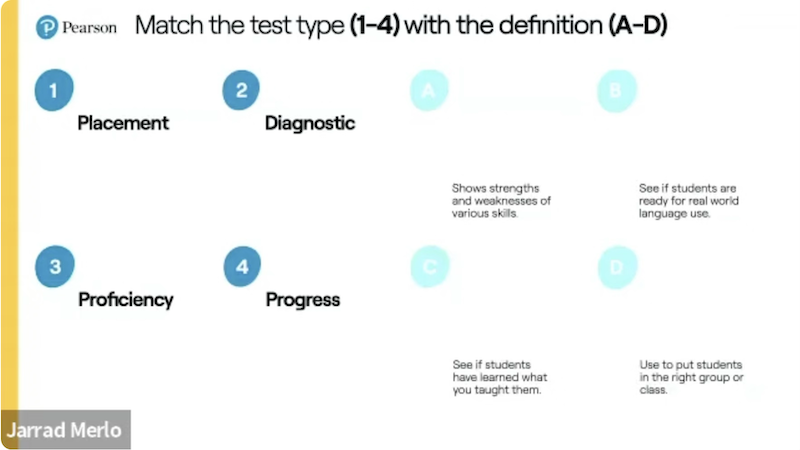
This tutorial demonstrates how generative AI can help create language-test images, scripts and audio, while emphasising that human expertise remains essential. Using an A2 listening item, it explains construct definition, level control and task design. AI outputs require editing, trialling and evaluation for accuracy, reliability, fairness, explainability and overall validity.
Learn more about this webinar
This tutorial demonstrates how generative AI can support—but not replace—human expertise when developing language assessments. Using an A2 listening progress-test item, the presenter first applies judgement to select the test purpose, proficiency level, construct, vocabulary and grammar, then adapts a task format from an assessment. Pearson’s GSE Teacher Toolkit is used to identify level-appropriate objectives and language. Generative AI then produces images, a listening transcript and synthetic audio. The demonstration exposes limitations: generated images may be culturally misleading, transcripts may exceed the proficiency level, and synthetic speech may be too fast or insufficiently authentic. Human editing, text-level analysis and audio adjustment are necessary. The item must be trialled and evaluated for accuracy, reliability, fairness and explainability. The webinar emphasises that validity is a multidimensional, evidence-based argument, not an automatic property of AI-generated content. AI can accelerate item development, but assessment professionals must define requirements, review outputs and collect sufficient evidence.
Personalising Learning with LMS Analytics
This webinar shows how LMS analytics can personalise learning through automated “if–then–else” pathways. Educators prepare varied content, map progression and remediation options, then use performance data to unlock lessons, assign support or provide advanced work. Dashboards reveal individual and group needs, while technology supports—not replaces—teachers’ professional judgement and learner guidance.
Learn more about this webinar
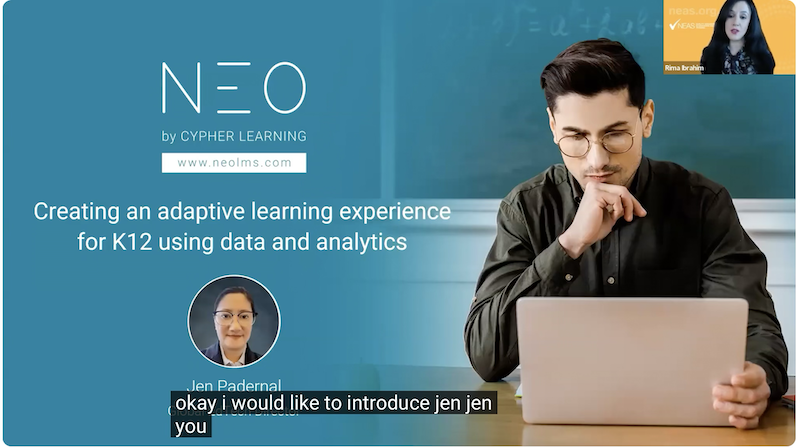
This webinar explains how learning management system analytics can support adaptive and personalised learning. Jen Paderno describes adaptive learning as an “if–then–else” process: learners progress when they demonstrate understanding, while those who need further support receive tutorials, additional practice or targeted assistance before attempting the next stage.
Effective implementation requires three elements: varied learning content, a clear blueprint mapping possible pathways, and technology capable of automating those pathways. An LMS should support different media, devices, delivery modes and assessment types while tracking engagement, results, progress, time spent and competency development. Dashboards, colour-coded reports and individual or group analytics can help educators identify challenging activities, learners requiring assistance and areas of the curriculum that may need revision.
Automated rules can unlock or hide lessons, assign remedial activities, issue badges, send notifications or provide extension work according to learner performance. The session demonstrates these functions through NEO LMS. Throughout, however, technology is presented as a support for professional practice rather than a replacement for teachers. Educators’ judgement, guidance and learning content remain essential to ensuring that each learner can progress.
Creative Online ELT: Practical Strategies for Engagement

This webinar shows how online-teaching constraints can stimulate creative activity design. Teachers can adapt communicative tasks using video, chat, reactions, screen sharing, breakout rooms and asynchronous platforms. Effective participation requires varied tools, clear instructions, structured turn-taking and meaningful outcomes, while movement and short screen breaks help reduce fatigue and disengagement.
Learn more about this webinar
This webinar uses animals, plants and ecosystems as metaphors for leadership. An Aboriginal story about a lizard becoming small introduces humility, empathy, identity and the influence of social feedback. Meerkats represent collaborative teaching, delegation and endurance, while ecological diversity illustrates the organisational value of diverse skills. Drawing on Julie Henry’s framework, the presenter identifies change, teamwork and resilience as leadership requirements. Mangroves model stability and a three-stage change process: assess current conditions, build an adaptable plan, then commit, communicate and act. Naked mole rats demonstrate shared effort and task allocation; tardigrades represent resilience, strategic patience and effectiveness despite limited resources. Biophilia and biomimetic leadership frame organisations as living, adaptive systems rather than mechanical structures. Porcupines illustrate balancing independence with collaboration, communicating through multiple channels, maintaining boundaries and building trust. Participants are encouraged to identify animal-inspired leadership traits with their teams and create a shared visual representation of their leadership model.
AI in the Classroom: Lessons from Training 40 Language Teachers
This webinar examines a project-based AI training program for 40 Indonesian English teachers. Training in prompting, content creation, assessment and ethics improved knowledge, confidence and practical use, culminating in published teaching materials. Participants nevertheless faced cognitive overload, poor connectivity, unsuitable outputs and ethical concerns, prompting slower, more critical follow-up training.
Learn more about this webinar
This webinar presents a project-based AI training program for 40 secondary English teachers in Malang, Indonesia. A preliminary survey of 78 teachers found positive attitudes toward AI but limited knowledge, infrastructure constraints and anxiety, especially among experienced teachers. Training covered AI foundations, prompting, text, image, audio and video generation, worksheet creation, learning applications, assessment and ethical use. Participants collaborated, received mentoring and feedback, revised materials and produced a published book of lessons. Pre- and post-training analysis reported statistically significant improvements in knowledge, attitudes and practice, with the largest change in practical AI use. Teachers described confidence, efficiency and motivation, while retaining responsibility for checking suitability, accuracy and ethics. Challenges included cognitive overload, excessive numbers of tools, unreliable connectivity, copy-pasting, weakened critical thinking and outputs pitched above students’ levels. Later training responded with slower pacing, individual projects, critical evaluation, ethics, moral values and continued peer support through an active WhatsApp community.
Digital Testing in Practice: Exploring the Laurate Platform
This webinar promotes Green Education Group’s Laurate online testing platform as a faster, cheaper alternative to paper-based assessment. It demonstrates customisable tests, randomised questions, AI-assisted marking, reporting, security and commercial features. However, its savings are based on hypothetical calculations, while evidence supporting test validity, reliability and AI-marking accuracy remains limited.
Learn more about this webinar
This webinar demonstrates Green Education Group’s Laurate Online Testing platform and examines the potential advantages of moving from paper-based to online assessment. The presenters argue that paper testing involves less visible costs associated with marking, administration and delayed results, while digital delivery can improve speed, consistency, scalability and convenience. Illustrative cost comparisons suggest possible savings, particularly for frequent progress testing, although these estimates are not presented as independent research findings.
The platform supports placement, progress, exit, language, literacy and numeracy, and mock testing. Features include custom question banks, randomised test assembly, automated and AI-assisted marking, human review, dashboards, downloadable reports, CEFR mapping, multi-campus administration, agent-issued links and paid public tests. Security measures include candidate photographs, IP tracking, copy-and-paste restrictions, page-exit warnings and activity logs.
A live demonstration covers test configuration, marking rubrics, result review, certificates and recovery of interrupted tests. The session emphasises affordability, customisation, support, a free trial and NEAS Product Endorsement. Its focus is primarily on platform functionality, with limited discussion of independent evidence concerning validity, reliability, test equivalence or AI-marking accuracy.
Going Digital at Speed: UQ ICTE’s Transformation Story
This case study examines how the University of Queensland’s Institute of Continuing and TESOL Education used technology to transition rapidly to online delivery. Managers discuss staff training, communication, digital learning materials, student engagement and secure online assessment, sharing lessons for building confidence, improving delivery and approaching future institutional change strategically.
Learn more about this webinar
This webinar presents a case study of how the University of Queensland’s Institute of Continuing and TESOL Education transformed its student experience through technology during major disruption. In conversation with ReadyTech, managers Neil Marsh and Ian Matheson describe the rapid transition from face-to-face teaching to online delivery, alongside changes to programs, staffing and operations. They explain how staff expertise, professional development, collaborative teaching practices and clear communication helped build confidence among teachers and students. The discussion examines evolving student expectations, online engagement and the development of secure online assessment using platforms and browser controls. It also considers practical lessons, including the importance of digital learning materials, coordinated messaging and adaptable training delivered through group, individual and self-access formats. Looking beyond the initial emergency response, the presenters reflect on which digital practices should continue, how technology can support pathway programs and how institutions can approach future change more deliberately and strategically.
Professional Growth and Credentials
PD That Makes a Difference: Building an Organisational Program
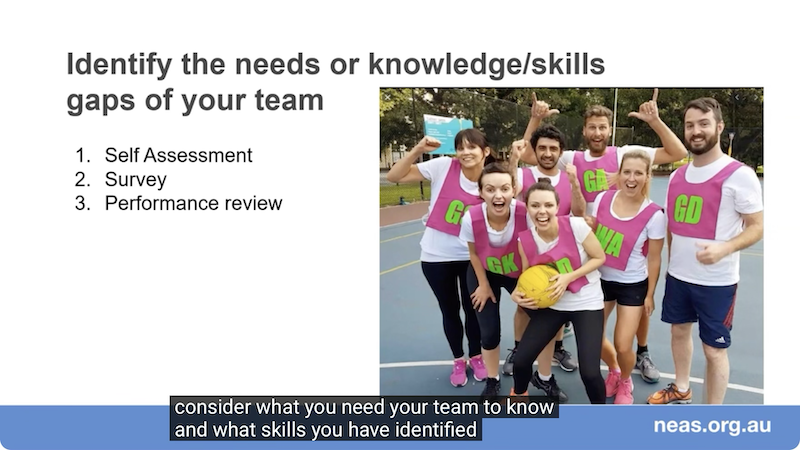
The webinar explains how providers can plan relevant, collaborative and future-focused professional development aligned with teacher needs, organisational strategy and student outcomes. Activities may include mentoring, peer observation, moderation, resource sharing, action research and study. Plans should reflect staff experience, available resources and institutional context, with participation documented and evaluated.
Learn more about this webinar
This webinar explains how providers can design effective professional-development programs for English language teachers. Continuing development can strengthen teaching quality, student engagement and learning outcomes while helping educators respond to diverse learner needs, technological change and evolving institutional priorities.
Strong programs should be relevant, collaborative and future-focused, with activities aligned to student needs, teachers’ career stages and organisational strategy. Planning can draw on teacher input, stakeholder feedback, self-assessment findings, industry research and strategic priorities. Providers should balance individual development goals with compliance requirements and centre-wide improvement needs.
Professional learning may include curriculum review, assessment validation and moderation, peer observation, mentoring, coaching, technical training, resource sharing, communities of practice, action research, conferences and formal qualifications. There is no single model suitable for every provider: timing, budget, staff composition and institutional context should shape the approach. Experienced teachers can contribute as mentors, presenters and course developers, allowing professional knowledge to be shared across the organisation. Participation should be documented, resources organised and accessible, and activities evaluated according to their contribution to improved professional practice and student outcomes.
Plan Your Year of Professional Growth
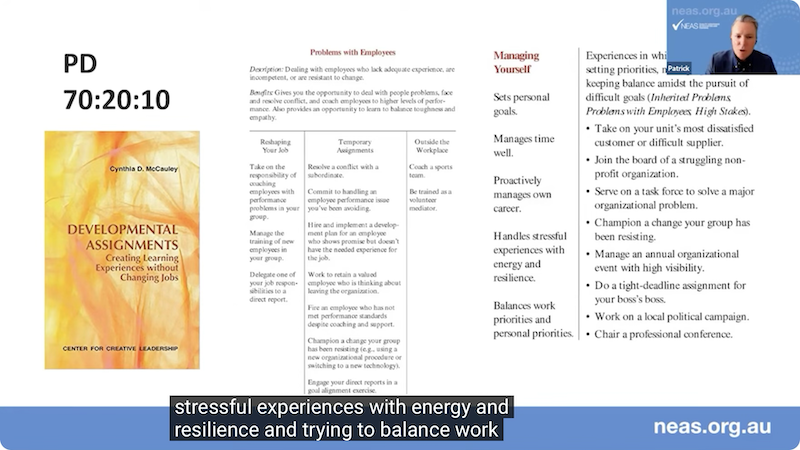
This webinar explains how to plan relevant, collaborative and future-focused professional development for English language teaching staff. Recommended activities include mentoring, peer observation, moderation, curriculum review and action research. Using the 70–20–10 model, plans should prioritise workplace learning, respond to identified needs, recognise career stages and support continuous organisational improvement.
Learn more about this webinar
This webinar guides planning a professional-development program for English language teaching staff. Effective PD should be relevant to student and organisational needs, collaborative, and future-focused to address changing technologies, delivery models and student expectations. Planning can begin by establishing a calendar, reviewing the previous year, conducting a needs analysis or defining a capability goal and breaking it into staged activities. The presenter recommends the 70–20–10 model: most development occurs through self-directed workplace experience, supported by structured internal learning and some formal external training. Activities may include mentoring, peer observation, team teaching, moderation, validation, curriculum review, action research, committees and new course development. Plans should reflect teachers’ career stages, recognise experienced staff as potential leaders and include managers’ development needs. Student feedback, regular performance reviews and organisational priorities should inform goals. Successful programs require clear structures, protected time, appropriate budgets, documentation, recognition of achievement and a broader culture of continuous learning.
The NEAS ELT Professional Pathway: CPD, Badges and Endorsement (2022)
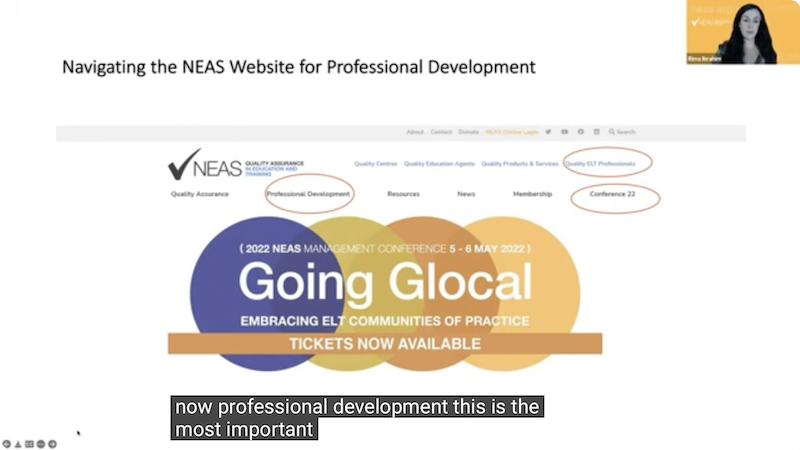
This webinar explains NEAS’s 2022 ELT Professional listing, associated badges and professional-development pathway. It outlines eligibility, maintenance requirements, online courses, CPD points and progression to Master Practitioner and professional endorsement. Practical scenarios encourage teachers to use mentoring, observation and targeted learning, while managers embed development within staff performance systems effectively.
Learn more about this webinar
This webinar introduces NEAS’s 2022 ELT Professional listing and related development pathway. Listed professionals were expected to demonstrate a connection to English language teaching, character and competence, commitment to growth, ethical participation and support for NEAS’s purpose. Applicants submitted a LinkedIn profile and photograph, then completed activities within 90 days to maintain their listing. Badges recognised membership, employment at an endorsed centre, completion of core or specialist courses, the Master Practitioner program and professional endorsement. The webinar outlines NEAS Online resources, including webinars, conference recordings, workshops, core courses and specialisations, carrying certificates and CPD points. The Master Practitioner pathway required prior courses, development evidence, references and a capstone project applying the Quality Assurance Framework. Scenarios encourage teachers moving into unfamiliar courses to review curricula, seek mentoring, observe experienced colleagues and undertake targeted learning. Managers are advised to assess staff capabilities, distribute development responsibilities and build continuous learning into performance-management systems.
Microcredentials and Digital Badges: The NEAS–Learning Vault Model
This webinar explains how short, stackable microcredentials can address changing workplace needs through focused, affordable learning. Education providers can convert existing expertise into credible courses and verifiable digital badges recording achievement details. Success depends on meaningful content, rigorous assessment and secure verification. The session also showcases NEAS’s Learning Vault badges.
Learn more about this webinar
This webinar introduces microcredentials as short programs enabling learners to acquire and demonstrate skills, knowledge or proficiencies without completing a full qualification. Nicholas Robert attributes their growth to changing careers, evolving industries, demand for just-in-time training, shorter study periods and lower costs. Technology companies pioneered the model, but education providers can use their expertise and credibility to develop high-quality offerings. Providers are encouraged to divide existing courses into meaningful, stackable components, create introductory “taster” programs and respond to workplace skills gaps. Digital badges can record the issuer, recipient, achievement criteria, issue date and validity, allowing employers to verify credentials and organisations to revoke them when necessary. However, credibility depends on rigorous learning and assessment; credentials should not reward trivial attendance, and online assessment may require secure identity verification and proctoring. The webinar concludes by demonstrating NEAS’s Learning Vault badges and their potential use on résumés, email signatures and social media.
Digital Credentials Explained: Making Professional Learning Visible

This presentation explores how digital badges can support lifelong learning for English language professionals. It explains how credentials can record, organise and share qualifications, professional development and achievements. Benefits for learners, institutions and employers are examined alongside credential pathways, global standards, blockchain, security, accessibility and the credibility of digital systems.
Learn more about this webinar
This conference presentation explores how digital badges and credentialing technologies can support lifelong learning for English language teachers, students and academic managers. Toby Jones explains how verified digital credentials can record professional development, qualifications and achievements in a portable backpack or education wallet. Learners can organise credentials into collections, share them with employers or education providers, and demonstrate a range of capabilities. For institutions, badges can strengthen brand visibility, reduce certificate administration and simplify verification, while employers gain access to trustworthy evidence of achievement. The session also examines pathways in which smaller badges accumulate towards larger credentials, including professional development requirements and credentials with expiry dates. Jones discusses maintaining global standards, avoiding excessive or trivial badge issuance, protecting long-term access and revoking credentials when necessary. Looking ahead, the presentation considers blockchain, smart contracts and lifelong digital records, while acknowledging questions about security, commercialisation, environmental impact and the credibility of systems.
Advance Your ELT Career with IELTS
This webinar introduces IELTS resources and development opportunities designed to support English language teachers’ careers. It covers Teaching Tips, teacher blogs, IELTS Progress Check, the IELTS Teacher Training Program, the Morgan Terry Memorial IATEFL Scholarship and Caroline Clapham Masters Award, emphasising professional learning, collaboration, further study and stronger classroom practice..
Learn more about this webinar
This webinar explores how IELTS resources and professional development opportunities can help English language teachers build expertise and advance their careers. Presented by representatives from IDP Education and the British Council, the session introduces materials, professional learning programs, scholarships and research awards. Teaching Tips and the IELTS teacher blog provide activities, lesson ideas and guidance for different learner levels. The presentation outlines the Morgan Terry Memorial IATEFL Scholarship, which supports IELTS preparation teachers attending an international conference, and the Caroline Clapham Masters Award, recognising outstanding master’s research in language assessment. Additional resources include IELTS Progress Check, the NEAS-endorsed IELTS Teacher Training Program and online materials for developing knowledge of assessment criteria and effective preparation practices. Throughout the webinar, the presenters emphasise sharing ideas, participating in communities and pursuing further study as valuable ways for teachers to strengthen classroom practice, expand professional networks and contribute to the English language teaching field.
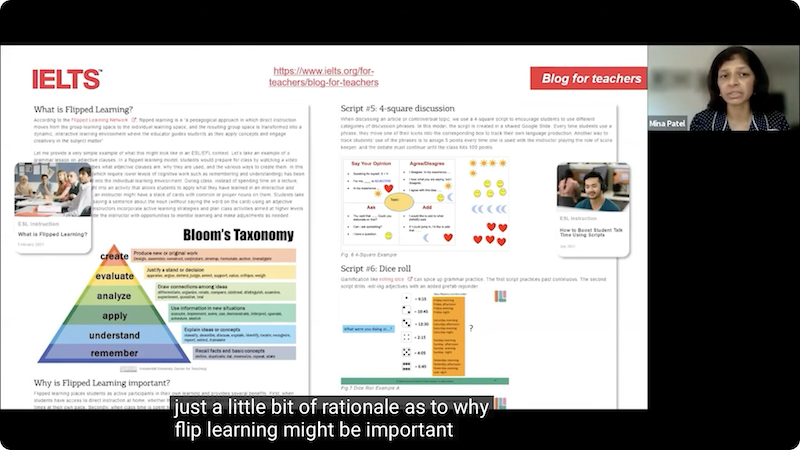
Leadership and Organisational Capability
Resilience by Design: Preventing Burnout in ELICOS
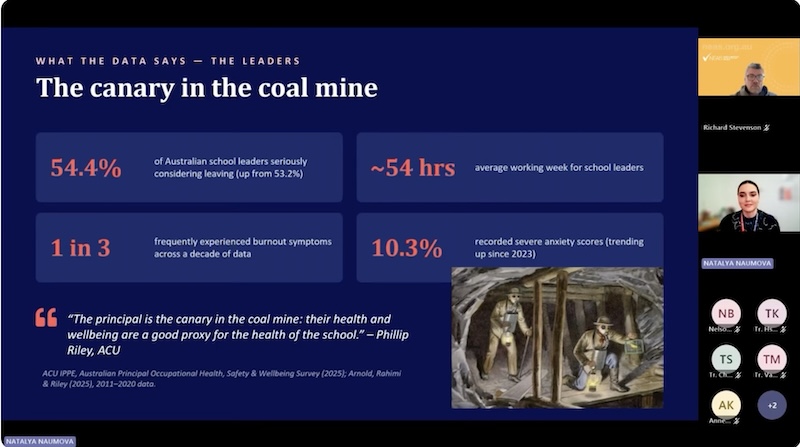
This webinar reframes teacher resilience as a workplace condition rather than an individual trait. Drawing on research and ELICOS practice, it examines burnout, emotional labour, casualisation and workload. Academic managers receive practical strategies for better timetabling, reduced administration, supportive performance management, recognition, teacher voice and sustainable leadership across education teams.
Learn more about this webinar
This webinar reframes teacher resilience as a working condition shaped by organisational design, rather than a personality trait or individual responsibility. Drawing on Australian research and ELICOS experience, Natalyia Lundi explains burnout as chronic workplace stress characterised by exhaustion, cynicism and reduced professional efficacy. Teachers face cumulative pressures including heavy workloads, compliance demands, emotional labour, mixed proficiency classes and insecure casual employment. Using the established job demands and resources model, the webinar shows how supportive leadership, trust, autonomy, recognition and adequate resources can directly protect wellbeing, commitment and teaching quality. Practical strategies include designing timetables around marking and recovery time, protecting breaks, reducing unnecessary administration, distinguishing developmental observation from evaluation, planning predictable workload peaks and involving teachers in decisions. Managers should provide specific recognition, include casual staff and model healthy boundaries by taking leave, seeking support and respecting the right to disconnect. Resilience, the webinar argues, must be designed collectively.
Lead Beyond the Classroom: Developing Teacher Leadership
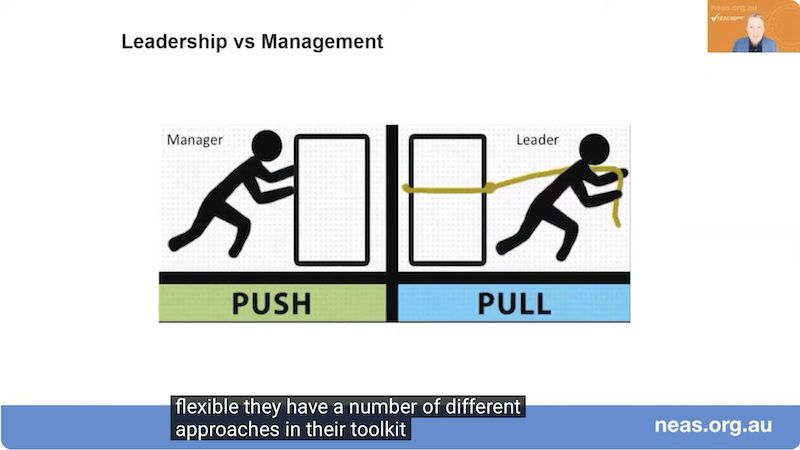
This webinar explains how English language teachers can lead beyond the classroom by influencing colleagues and organisational improvement. Effective leadership is flexible, future-focused and grounded in reflection, workplace learning and continual development. Strong leaders build self-awareness, resilience and cultural intelligence while fostering feedback, innovation, inclusion and better overall student experiences..
Learn more about this webinar
This webinar explores how English language teachers can develop as leaders within their classrooms, organisations and the wider profession. It distinguishes management, which concentrates on current operations, from leadership, which helps people and organisations move towards a desired future. Effective leadership is presented as contextual and flexible, drawing on emergent, authentic, inspirational and transformational approaches.
Teachers are encouraged to consider their career stage, reflect critically on their practice and decide whether to deepen their specialist expertise or develop broader management and leadership capabilities. Because formal leadership pathways within English language teaching may be limited, much professional growth occurs through workplace experience. Opportunities include coaching colleagues, managing projects, delegating responsibilities, experimenting with new approaches and undertaking action research.
Strong learning organisations enable leadership development through clear goals, constructive feedback, professional learning, quality-assurance processes and responsiveness to students. Emerging leaders should also cultivate self-awareness, emotional and cultural intelligence, adaptability, resilience, inclusion and a global perspective. Ultimately, teacher leadership involves influencing colleagues, contributing to organisational improvement and strengthening students’ learning experiences, whether or not the teacher holds a formal management position.
Build and Keep a Great Teaching Team
This webinar guides academic managers through attracting, recruiting, onboarding, developing and retaining quality teachers. It stresses transparent expectations, careful recruitment, structured induction, ongoing professional development and fair performance review for all staff, including casuals. Positive relationships, open communication, manageable workloads and documented processes support staff wellbeing, teaching and organisational stability.
Learn more about this webinar
This webinar presents a practical staffing toolbox for academic managers, covering the complete employee lifecycle: attraction, recruitment, onboarding, development, retention and separation. Because teaching quality directly influences the student experience and organisational reputation, providers are encouraged to establish an ethical workplace culture and use transparent recruitment practices.
Position information should clearly communicate required qualifications, remuneration, duties, working conditions and professional-development expectations. Reference checks, qualification verification and demonstration lessons can help managers identify suitable candidates. Once appointed, staff need structured onboarding that introduces the organisation’s values, policies, reporting arrangements and performance expectations. An induction checklist and regular managerial follow-up can help ensure that essential information is understood and applied.
Ongoing development may include formal and peer observations, mentoring, communities of practice, moderation, validation and varied professional-learning opportunities. Casual and short-term teachers should also receive appropriate feedback and access to development. Retention is supported by positive relationships, open communication, manageable workloads and responsiveness to staff concerns. Where performance issues arise, managers should use fair, consistent and documented processes linked to position descriptions, agreed goals and reliable evidence. Clear records protect both employees and organisations.
Running an Effective ELT Centre: Structures, Staffing and Communication
This webinar explains NEAS Quality Area D, covering organisational structures, staff recruitment, stakeholder communication and performance development. Providers need clear reporting lines, documented policies, accurate position descriptions and effective induction. Mentoring, appraisal, observation and professional learning should form a development cycle aligned with organisational priorities and focused on student services.
Learn more about this webinar
This webinar examines NEAS Quality Area D: Administration, Management and Staffing. Its four principles address organisational structures that support student services, compliant recruitment practices, effective stakeholder communication and continuing staff performance development.
Clear reporting lines, accountable management structures and documented policies help prevent conflicting instructions, staff exhaustion, poor service, weak teamwork and missed opportunities for innovation. Recruitment processes should verify applicants’ qualifications and experience, while position descriptions should clearly define duties, employment conditions, reporting arrangements and responsibilities. Information should be communicated consistently to students, staff and education agents through accessible channels, supported by clear guidance and effective pre-arrival communication.
Structured induction is presented as the foundation of staff development. It should cover reporting relationships, working conditions, organisational systems, policies, health and safety, student welfare, available resources, appraisal processes and professional-development expectations. Extended induction, mentoring and practical training can help new employees become effective and engaged. Performance management should operate as a documented cycle incorporating observation, appraisal, professional goals and learning opportunities. Organisations should also recognise achievement, encourage staff-led learning, record innovation and align development activities with strategic priorities.
What Nature Can Teach Us About Leadership
This webinar draws leadership lessons from animals, plants and ecosystems. Mangroves represent stability and planned change; naked mole rats demonstrate teamwork; tardigrades illustrate resilience and strategic pauses; and porcupines model boundaries and trust. Its message is that diverse, adaptive organisations can learn from nature’s approaches to collaboration, survival and change.
Learn more about this webinar
This webinar uses animals, plants and ecosystems as metaphors for leadership. An Aboriginal story about a lizard becoming small introduces humility, empathy, identity and the influence of social feedback. Meerkats represent collaborative teaching, delegation and endurance, while ecological diversity illustrates the organisational value of diverse skills. Drawing on Julie Henry’s framework, the presenter identifies change, teamwork and resilience as leadership requirements. Mangroves model stability and a three-stage change process: assess current conditions, build an adaptable plan, then commit, communicate and act. Naked mole rats demonstrate shared effort and task allocation; tardigrades represent resilience, strategic patience and effectiveness despite limited resources. Biophilia and biomimetic leadership frame organisations as living, adaptive systems rather than mechanical structures. Porcupines illustrate balancing independence with collaboration, communicating through multiple channels, maintaining boundaries and building trust. Participants are encouraged to identify animal-inspired leadership traits with their teams and create a shared visual representation of their leadership model.
Leading for Quality: People, Systems and Student Experience
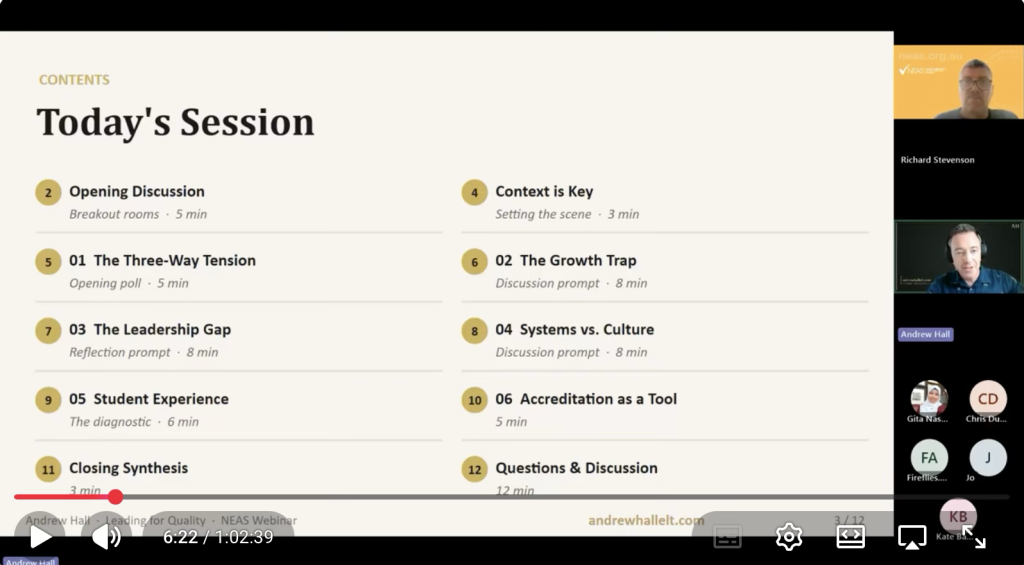
This webinar explores how leaders can balance student experience, staff engagement and sustainable growth. Andrew Hall discusses instructional leadership, teacher support, induction, observation, professional development and systems. He encourages leaders to place students at the centre, use accreditation for continuous improvement and progress from immediate management to critical organisational reflection.
Learn more about this webinar
This webinar explores how academic leaders can maintain quality while balancing student experience, staff engagement and sustainable growth. Andrew Hall emphasises that leadership must reflect context, whether working with young learners, pathway students, adults or corporate clients. Rapid growth can create recruitment pressure, inconsistent induction, heavier workloads, reduced development and declining classroom quality. New academic managers are encouraged to begin with instructional leadership: supporting teachers through workshops, co-planning, mentoring and resolving classroom obstacles. Sustainable quality also requires dependable systems for induction, observation, professional development, leave, assessment and cross-departmental collaboration. Student experience should remain central to decisions about staffing, class sizes, complaints, feedback and retention. Accreditation can support continuous improvement when standards are understood, shared and used for self-assessment rather than treated as compliance. The session concludes with a functional, critical and socially critical framework helping leaders progress from managing immediate operations to questioning purpose, decision-making, beneficiaries and wider organisational impact.
What Motivates Teachers? Building Engagement and Growth
This interactive webinar examines how managers can motivate English language teachers through professional development, workplace projects, peer learning and constructive feedback. It explores individual sources of motivation, career stages and effective learning organisations, highlighting how supportive leadership and clear goals can strengthen teacher engagement, retention, classroom performance and succession planning.
Learn more about this webinar
This interactive webinar explores ways to motivate English language teachers and build an engaging, supportive workplace. Patrick Pheasant examines how managers and leaders can encourage professional development, maintain the engagement of experienced staff, support action research and create a culture where constructive feedback is welcomed. Participants discuss challenges affecting teacher motivation, including delivery models, employment uncertainty, career stages and the need to adapt professional support to circumstances. The session presents the 70–20–10 approach to professional learning, emphasising experience and workplace projects alongside peer learning and formal training. It also considers the characteristics of effective learning organisations, including clear goals, responsive leadership, opportunities for growth and mechanisms for upward feedback. Through discussion and reflection, participants identify different sources of motivation and consider how managers can connect organisational priorities with individual values, strengths and aspirations. The webinar highlights the benefits of motivated teachers for retention, classroom performance, succession planning and workplace culture.

Lead Through Change: Building Resilience, Adaptability and Agility
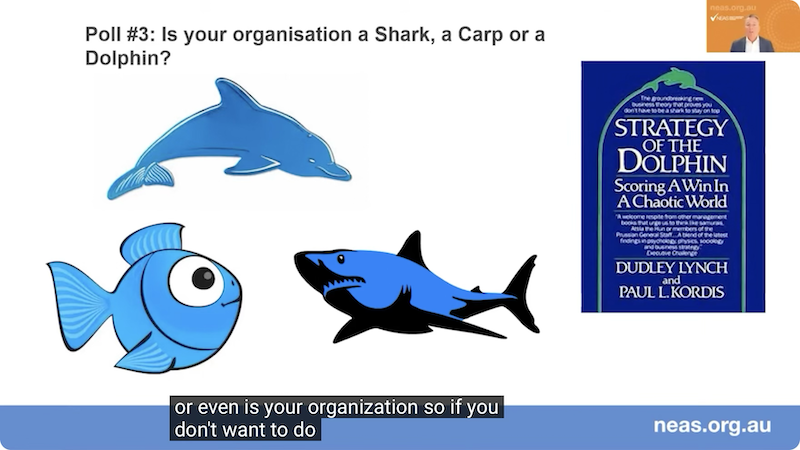
This webinar examines how English language teaching organisations can build resilience, adaptability and agility during change. It connects organisational readiness with strategic planning, governance, stakeholder engagement and risk management. Participants explore change capability, systems thinking, organisational design and emotional and cultural intelligence, gaining guidance for supporting staff and maintaining quality.
Learn more about this webinar
This webinar explores how English language teaching organisations can strengthen resilience, adaptability and agility in periods of change. Patrick Pheasant draws on provider experiences to examine why some institutions respond to disruption while others struggle to pivot. The session connects organisational readiness with NEAS Quality Area G, highlighting the importance of strategic planning, governance, stakeholder engagement and risk management. It considers how a responsive strategy, informed risk appetite and communication can help organisations adjust while maintaining educational quality. The webinar also introduces perspectives on change management, including personal change capability, working with teams, systems thinking and organisational design. Emotional intelligence, cultural intelligence and adaptability are presented as complementary capabilities for leaders navigating uncertainty. Participants are encouraged to examine how structures, meetings, workloads and communication practices influence organisational agility. Through reflection and discussion, the session offers guidance for supporting staff, preparing for disruption and embedding change as an ongoing organisational capability.
The Four Cs of Transformation
Professor Anne Burns explores transformative education through crisis, confusion, collaboration and creativity. She presents confusion as a productive trigger for learning when supported by relationships, experimentation and shared inquiry. Drawing on teacher action research, the presentation encourages educational leaders to embrace uncertainty, sustain collaboration and turn disruption into lasting improvement.
Learn more about this webinar
In this conference presentation, Professor Anne Burns explores transformative education through four themes: crisis, confusion, collaboration and creativity. Drawing on research and teacher experiences during widespread disruption, she challenges the assumption that confusion is negative. Instead, confusion can become a productive trigger for learning when educators receive structured support and work within a “zone of optimal confusion”. Burns shares examples from teacher action research showing how rapid shifts in delivery encouraged experimentation while keeping pedagogy, student engagement and relationships at the centre of practice. She argues that transformation involves letting go of familiar approaches, tolerating uncertainty and moving through cycles of unfreezing, change and renewal. For educational leaders, the presentation emphasises creating supportive environments, inviting ideas from across the organisation and replacing negative discourse with curiosity and possibility. Collaboration, active listening, experimentation and attention to sustainability can help institutions turn disruption into shared learning, creative practice and lasting improvement.

Finance for Education Managers: Reading the Numbers That Matter
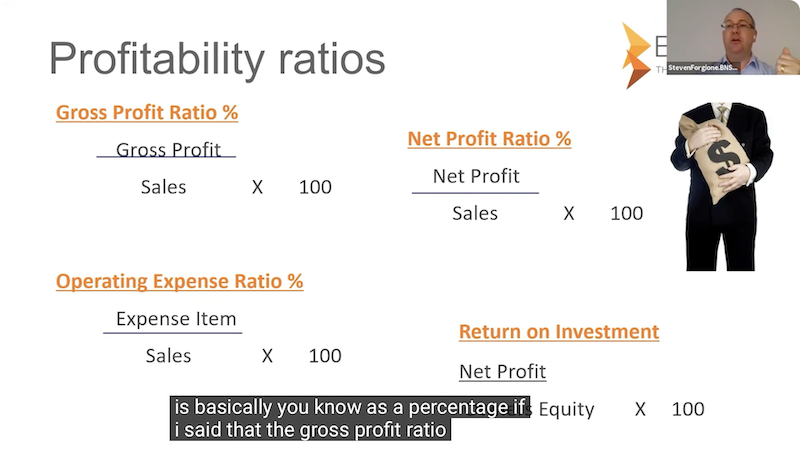
This introductory presentation helps education managers understand financial statements and assess business performance. It explains cash and accrual accounting, profit and loss statements, balance sheets and cash-flow statements. Participants also learn to interpret profitability, liquidity, debt and efficiency ratios, compare results over time and identify areas requiring strategic management attention.
Learn more about this webinar
This introductory accounting presentation helps education managers interpret financial information and assess business performance. Stephen Forgione explains the difference between cash and accrual accounting and traces how transactions move from source documents and journals through the general ledger and trial balance into financial statements. The session examines the profit and loss statement, balance sheet and cash-flow statement, clarifying what each reveals about profitability, financial position, liquidity and the movement of money. Examples demonstrate the relationship between assets, liabilities, equity, revenue, expenses and retained profits, and explain why a profitable organisation may still face cash-flow difficulties. The presentation introduces financial ratio analysis as a tool for informed decision-making. Ratios covering gross and net profit, operating expenses, return on investment, working capital, quick assets, debt to equity, stock turnover and debtor collection are explained. Participants learn to compare results over time, against budgets and industry benchmarks, and identify areas requiring management attention.
Professionalism with Purpose: Trust, Ethics and Responsibility
This presentation explores how trust, ethics and responsibility shape professional identity. Through personal career journeys, the presenters examine education as a moral endeavour, the T-shaped professional and five foundations of professionalism: education, ethics, experience, examination and entity. They emphasise combining specialist expertise with accountability, humanity, governance and service to society.
Learn more about this webinar
This conference presentation explores how trust, ethics and responsibility shape professional identity in English language teaching. Drawing on their own career journeys, the presenters reflect on the experiences, challenges and mentors that influenced their understanding of what it means to act professionally.
The session presents education as a moral endeavour, connecting professional practice with graduate outcomes, social contribution and the responsibilities that accompany specialist expertise. It also considers how funding arrangements, commercial pressures and organisational governance can either strengthen or undermine public confidence in education.
The presenters introduce the concept of the T-shaped professional: an individual who combines deep disciplinary expertise with broad knowledge, advocacy skills and a commitment to serving society. They also identify five foundations of professionalism—education, ethics, experience, examination and a representative entity—and position NEAS as an organisation that can support quality, standards and professional recognition within English language teaching. The presentation concludes that technical expertise alone is insufficient. Professionals earn trust and contribute meaningfully to their communities when specialist knowledge is combined with humanity, accountability, ethical conduct and evidence-based advice.
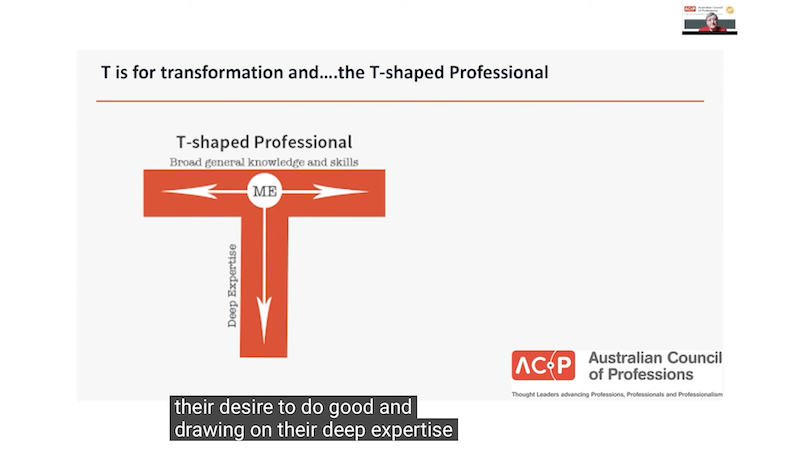
Quality Assurance and Continuous Improvement
Benchmark Better: Turning Comparison into Improvement
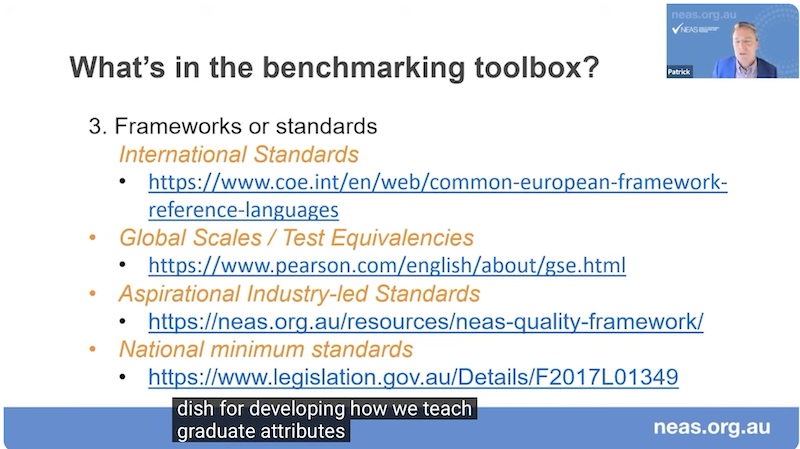
This webinar presents why benchmarking is essential to quality assurance and continuous improvement. Providers should compare curricula, assessments, outcomes and teaching practices against multiple credible standards and triangulate findings. Useful methods include external test mapping, peer comparisons, tracer studies, surveys and moderation. Results should be documented and used to drive improvement.
Learn more about this webinar
This webinar presents benchmarking as a core component of quality assurance and continuous improvement in English language teaching. Benchmarking involves comparing courses, assessments, learner outcomes, staff practices or organisational performance with credible standards, frameworks, external tests, partner institutions or peer providers.
Providers are encouraged to use multiple benchmarking activities and triangulate their findings rather than relying on a single source of evidence. A strong benchmarking toolbox may include well-designed syllabuses, moderated and validated assessments, external frameworks, test mapping, tracer studies, peer-course comparisons, stakeholder surveys and sector research. Benchmarking should consider both curriculum consistency and teaching practice while allowing teachers to respond appropriately to different learner needs. Frequent and varied assessment, supported by clear rubrics, can strengthen the reliability of judgements about integrated language skills and broader graduate attributes.
Long-term partnerships and longitudinal research can increase the credibility of benchmarking activities. Careful documentation—including policies, assessment samples, meeting records, survey findings and reports—provides evidence of the process. Most importantly, findings should lead to course redesign, professional development and service improvement, ensuring that benchmarking produces demonstrable change rather than becoming a compliance exercise.
Setting the Standard: IELTS Benchmarking, Equivalency and Student Success
This webinar explores how research, concordance studies and government policy inform English language test interpretation. IELTS representatives examine links between proficiency and academic success, recent Home Affairs changes, revised score comparisons and TOEFL developments. Providers are encouraged to update equivalency tables, strengthen assessment literacy and support more accurate placement decisions.
Learn more about this webinar
This webinar examines how research, concordance studies and government policy shape the interpretation of English language test scores. IELTS representatives explain evidence linking language proficiency with academic readiness, early university performance and resilience, while highlighting risks created by inconsistent equivalency settings across institutions and professions. The session reviews Department of Home Affairs changes introduced in 2025, including approved tests, revised score comparison tables, secure test centre requirements and implications of the redesigned TOEFL. Providers are encouraged to review outdated concordance tables, consider differences between overall and individual skill scores, and ensure placement and entry decisions reflect evidence. Practical recommendations include recalibrating internal tests, strengthening staff assessment literacy and helping teachers understand what scores indicate about learner capability and support needs. The webinar also outlines IELTS teacher development resources and encourages institutions to examine research from multiple test providers when setting requirements, supporting compliance, appropriate placement and stronger student outcomes overall.
Quality Assurance Essentials: From Compliance to Continuous Improvement
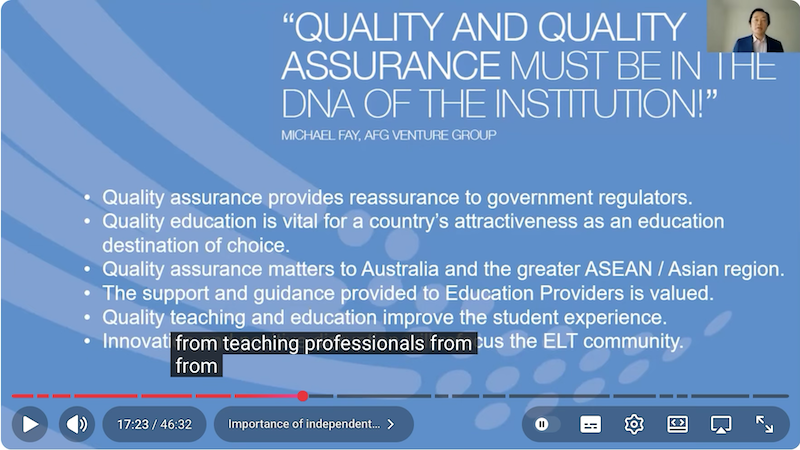
This webinar introduces NEAS as an independent quality assurance organisation for English language teaching. It explains the Quality Assurance Framework, distinguishes quality assurance from regulatory compliance, and outlines endorsement through evidence review, stakeholder consultation and continuing self-assessment. NEAS acts as a critical friend, providing validation, guidance and professional-development resources and support.
Learn more about this webinar
This webinar introduces NEAS as an independent quality-assurance organisation supporting English language teaching providers, professionals, education agents and product or service suppliers. The NEAS Quality Assurance Framework establishes standards across teaching, assessment, student welfare, governance, staffing, resources, promotion and specialised forms of delivery, with the student experience at its centre.
The session distinguishes regulatory compliance from quality assurance. Compliance involves meeting legal and regulatory obligations, while quality assurance focuses on the systems, procedures and organisational culture required to deliver consistent quality and support continuous improvement. NEAS endorsement begins with a documentary review, followed by an assessment involving management meetings, staff and student focus groups, and the triangulation of evidence from different sources. Continuing endorsement includes alternating NEAS-led reviews and provider-led self-assessments.
Independent assessment can provide objectivity, external validation, practical recommendations, regulatory reassurance and market differentiation. NEAS describes its role as that of a “critical friend” rather than a regulator, recognising effective practice while identifying opportunities for improvement. Members can access professional-development resources, and individual practitioners may complete courses and a workplace project towards NEAS professional endorsement.
Learning Spaces That Work: Facilities, Resources and Technology
This webinar explains NEAS Quality Area C, covering premises, teaching spaces, student facilities, course resources and material development. Providers need safe, accessible environments, suitable technology, communal spaces and varied learning resources, including self-study options. Teachers require tools and support to create materials, while online platforms must function across devices reliably.
Learn more about this webinar
This webinar examines NEAS Quality Area C: Resources and Facilities. Its five principles address professional premises, suitable teaching and study spaces, student facilities, course resources, and teachers’ capacity to create and improve learning materials.
Physical premises should be safe, clean, appropriately furnished and easy to navigate, with clear signage, an accessible reception area and adequate amenities. Classrooms, laboratories and independent study spaces should support learning, participation and current delivery methods. Shared areas and accessible information can also encourage interaction, belonging and a stronger student community.
Courses require varied and current resources that respond to learners’ needs, including opportunities for self-directed study and assessment methods aligned with intended outcomes. Resources should be organised, monitored, validated and moderated to maintain quality and consistency. Teachers need suitable workspaces, budgets, technology and organisational encouragement to develop, evaluate and share innovative materials. For online delivery, learning platforms should function across common devices, staff and students need appropriate digital skills and training, and reliable technical support must be available. Providers are encouraged to evaluate their material, human and financial resources regularly against student needs, course requirements and organisational goals.
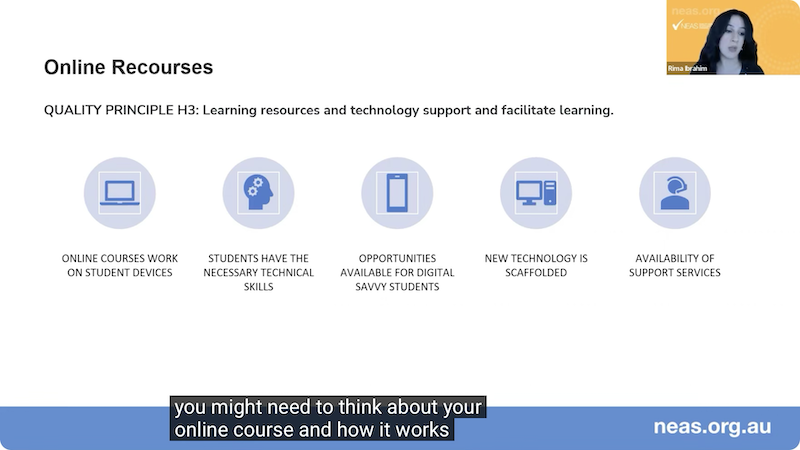
Quality by Design: How NEAS Evaluates ELT Products and Services
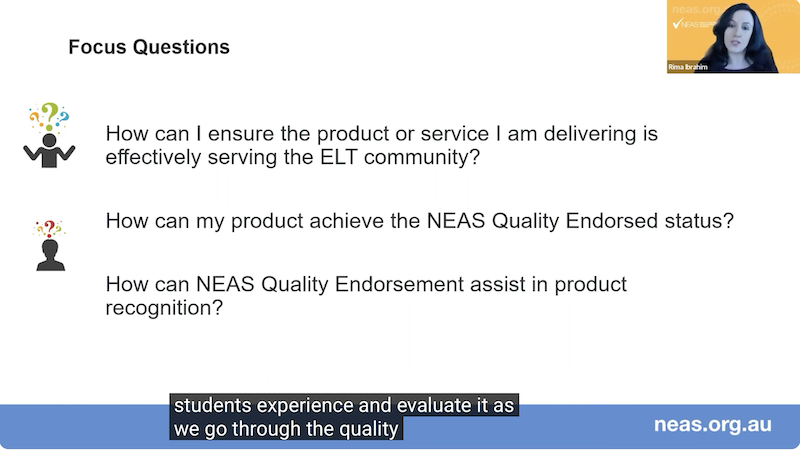
This webinar outlines NEAS Quality Area K for evaluating ELT products and services. Its five principles address research, fitness for purpose, ongoing quality, innovation and contribution to education. It also explains the endorsement application and claimed recognition benefits, before shifting into promotion of NEAS membership, professional development and associated events.
Learn more about this webinar
This webinar introduces NEAS Quality Area K, which provides a framework for evaluating products and services used within English language teaching. Relevant offerings may include homestay services, insurance, publishing, testing, educational media and student-management systems.
The framework contains five principles. Products and services should be developed through research and identified needs; fulfil their intended purpose through usability, value and currency; include processes for maintaining and validating quality; demonstrate innovation informed by stakeholder feedback; and contribute to education, English language teaching or cultural development. Organisations seeking endorsement complete an online application and respond to the Area K requirements, supported by evidence such as testimonials, reviews, graphics or case studies.
NEAS presents endorsement as an independent review that can demonstrate commitment to quality, strengthen recognition and create promotional or networking opportunities through its website, events and conference. Approximately half of the session focuses on the Area K framework and application process. The remaining portion introduces NEAS associate membership, professional-development courses, badges, communities of practice and conference activities. Some information about these services and events reflects what was available when the webinar was recorded.
Quality in Action: ELC Malaysia’s Improvement Journey
ELC Malaysia uses the NEAS Quality Assurance Framework as an ongoing, practical improvement tool, integrating surveys, observations, moderation and professional development. Practical initiatives address assessment consistency, teacher growth and burnout, student autonomy, cultural orientation and facilities. The webinar emphasises teacher involvement, student voice, transparent management, organisational buy-in and sustained follow-through.
Learn more about this webinar
This webinar shows how ELC Malaysia uses the NEAS Quality Assurance Framework as an everyday improvement tool rather than an annual compliance exercise. Focusing on teaching and assessment, the student experience, resources and staffing, Daniel Furtado explains how the organisation gathers evidence through surveys, focus groups, classroom observations and self-assessment.
Inconsistent assessment practices are addressed through twice-yearly moderation, collaboration across centres and targeted induction for new teachers. A year-round observation cycle informs professional development, while teachers with particular strengths are invited to lead peer-learning sessions and take on leadership responsibilities. Strategies for reducing burnout among experienced teachers include project work, mentoring, lighter teaching periods and opportunities to repeat classes rather than continually preparing new material.
Student autonomy is supported through student-led study-skills sessions, while locally led Discover Malaysia activities help learners adjust to their surroundings and recognise the expertise of Malaysian teachers. The session also acknowledges continuing challenges involving facilities and staff workloads. Its central message is that effective quality assurance depends on transparency, teacher involvement, responsive management, student voice, organisational commitment and consistent follow-through.
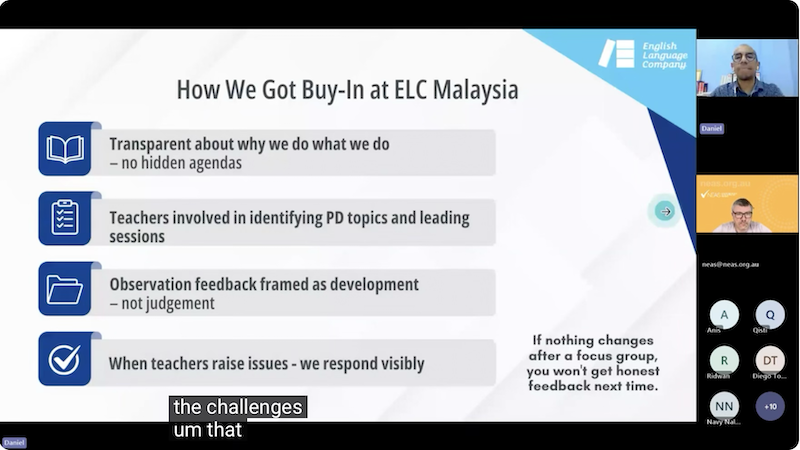
From Compliance to Culture: Making Quality Everyone’s Responsibility (in Bahasa Indonesia)

This Indonesian-language panel argues that quality assurance should become an institution-wide academic culture rather than an accreditation exercise. Speakers criticise document-driven compliance, weak coordination and excessive administration. They advocate rigorous learning, shared responsibility and prepared middle leaders who explain quality’s purpose, engage staff, model good practice and sustain continuous improvement.
Learn more about this webinar
This Indonesian-language panel argues that quality assurance in higher education must become an academic culture rather than an accreditation exercise. Speakers question why decades of accreditation have not improved graduate quality or work-readiness. Document-heavy, seasonal compliance can encourage reconstructed evidence, administrative workloads, weak coordination, limited staffing and the assumption that quality is solely a QA-unit responsibility. Effective internal quality assurance should instead be integrated into teaching, curriculum and assessment, supported by reflection, transparency and institution-wide ownership. The discussion emphasises rigorous learning, student independence, meaningful lecturer feedback and resistance to making courses easier to attract enrolments. Attention centres on middle leaders, who should be prepared as change agents rather than assumed capable because they hold doctorates. Leaders must explain the purpose behind standards, create dialogue, model consistent practice and sustain improvement through leadership transitions. Ultimately, quality assurance is presented as a moral commitment to deliver the educational outcomes institutions promise students.
Transnational Education and Foundation Pathways
Quality Across Borders: The NEAS Framework for Transnational Delivery
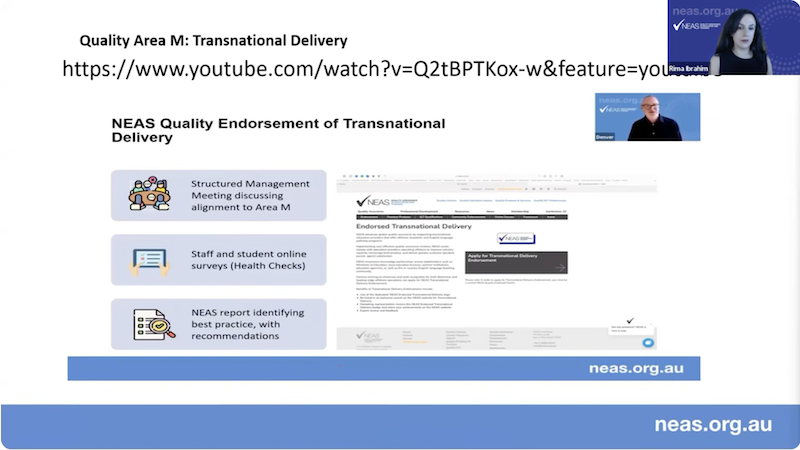
This webinar explains transnational education and NEAS Quality Area M. Providers need strong partnerships, clear contracts, host-country compliance, culturally responsive curricula, equivalent outcomes, suitable staffing and integrated quality systems. Effective delivery also requires stakeholder feedback, benchmarking, student support and accessible technology. NEAS endorsement uses management discussions, surveys and improvement recommendations.
Learn more about this webinar
This webinar introduces transnational education as the movement of people, educational programs or institutions across national borders. Examples include offshore campuses, courses delivered through partner organisations and online teaching for students located overseas. Transnational delivery can help providers grow internationally and develop cultural understanding, while giving students access to education without requiring them to leave their families and support networks.
NEAS Quality Area M identifies four requirements: strong institutional partnerships; comparable and culturally responsive program delivery; systematic evaluation and continuous improvement; and a contribution to global education and Australia’s educational reputation. Providers need to understand host-country regulation and culture, establish contracts defining responsibilities and exit arrangements, internationalise curricula with local expertise, maintain equivalent outcomes and assessment standards, and provide suitable staffing, resources and student support.
Quality-management systems should connect partner institutions, gather stakeholder feedback and benchmark offshore delivery against both onshore programs and external providers. The session also outlines the NEAS endorsement process, including management discussions, staff and student surveys, and a report identifying strengths and improvement opportunities. Online transnational delivery additionally requires accessible technology, meaningful interaction, appropriate assessment, clear reporting, effective orientation and reliable technical support.
Building Strong Foundation Programs: Quality, Pathways and Student Support
This webinar explains foundation programs and NEAS Quality Area N. Effective programs combine academic English, discipline knowledge, university-style learning, outcomes-aligned assessment, cultural preparation and student support. They require close collaboration with pathway institutions and responsiveness to destination-course changes. NEAS endorsement reviews curricula, staffing, policies and partnerships as a benchmarking exercise
Learn more about this webinar
This webinar examines foundation programs, which combine academic English with discipline-based subjects to prepare international students for undergraduate study. Programs may provide broad preparation across several disciplines or offer specialised streams leading towards particular degrees.
NEAS Quality Area N contains seven principles addressing collaboration with destination institutions, academic-English preparation, discipline knowledge, university-style teaching and learning, outcomes-aligned assessment, cultural competence and student support. Providers should maintain regular communication with pathway partners, respond to changes in destination courses and establish realistic entry and exit requirements. Delivery should develop academic, technological, information and media literacy through lectures, tutorials, group work and independent learning.
Assessment tasks must align with intended outcomes, use clear criteria and be communicated to students in advance. Programs should also prepare learners for Australian academic culture, cross-cultural engagement and the support systems available within universities. The webinar outlines the NEAS endorsement process, which includes reviewing curricula, staffing, policies, pathway arrangements and published information, followed by a management discussion identifying strengths and improvement opportunities. The process is presented as a structured benchmarking and quality-improvement activity rather than regulatory accreditation.
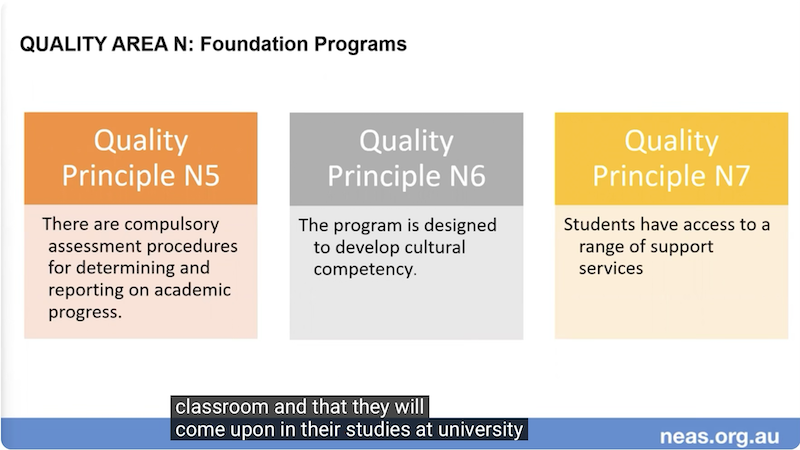
Transnational Partnerships in Practice: Beyond Borders
Using UOW College and panel examples, this webinar applies NEAS transnational-delivery principles to practice. It emphasises trusted partnerships, contracts, regulatory compliance, locally adapted delivery, equivalent outcomes, assessment moderation and benchmarking. Benefits include student pipelines and professional exchange, but partnerships take time, face support challenges and are not a quick revenue source..
Learn more about this webinar
This webinar revisits NEAS transnational-delivery principles through UOW College’s offshore programs and a practitioner panel. UOW College supplies curriculum, assessments, quality assurance, staff training and ongoing academic support, while partner institutions provide facilities, teachers, marketing and administration. Success depends on trusted relationships, supported by contracts, due diligence, clear responsibilities, local regulatory compliance and an exit strategy protecting students. Programs should maintain equivalent outcomes while adapting delivery to class sizes, technology restrictions, cultural expectations and available student support. Assessment standards are maintained through moderation, staff oversight, stakeholder feedback, governance reporting and benchmarking against Australian cohorts. Panellists identify benefits including student pipelines, smoother transitions to Australian study and reciprocal professional learning. They also emphasise lengthy partner development, differing national regulations, financial constraints and the difficulty of reproducing Australian support systems offshore. Transnational delivery is therefore presented not as a quick revenue replacement, but as a relationship-based component of a broader institutional strategy.
Transnational Education in Practice: Trends, Risks and Opportunities
A NEAS–BONARD survey and practitioner panel examine transnational education, particularly in China and Vietnam. Providers report opportunities in new markets, collaboration, innovation and revenue, alongside regulatory, quality, cultural and staffing challenges. Successful delivery requires careful market and partner research, realistic timelines, detailed agreements, professional development, moderation and continuing quality oversight.
Learn more about this webinar
This webinar presents findings from a small NEAS–BONARD survey alongside the practical experiences of providers delivering transnational education. Among responding NEAS members, 40 per cent were already delivering internationally, primarily in China and Vietnam, while almost two-thirds of those not currently involved were considering future participation. Southeast Asia emerged as the strongest prospective region, with online and distance learning, franchise arrangements and joint degrees among the most common delivery models.
Providers identified regulation, accreditation, quality assurance, partner collaboration, cultural differences and staffing as significant challenges. Reported benefits included access to new markets, international academic collaboration, stronger brand recognition, innovation and additional revenue.
Panellists delivering Australian programs in Vietnam and China emphasise the importance of rigorous market and partner research, realistic timeframes, detailed third-party agreements and continuing oversight. Their experiences demonstrate the lengthy approval processes that may apply in Vietnam and the need to adapt teaching methods and classroom expectations in China. Student surveys, assessment moderation, professional development, site visits and standards equivalent to onshore delivery are presented as essential safeguards for program quality and integrity.
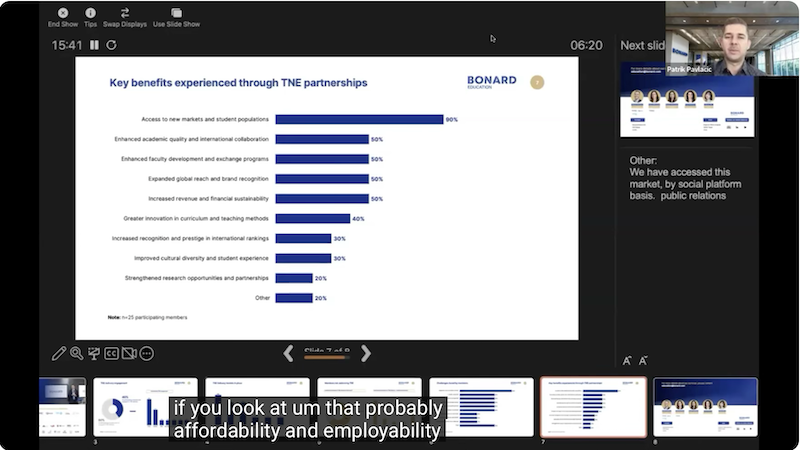
Regulation, Copyright and Student Protection
Essential Cover Explained: OSHC and Homestay Protection (2024)
This webinar covers mandatory Overseas Student Health Cover and specialist homestay liability insurance. OSHC assists with eligible medical costs and may include digital, telehealth and wellbeing services. Homestay cover addresses negligent injury or property damage between hosts and students where ordinary policies may not respond. Specific 2024 details require verification.
Learn more about this webinar
This webinar examines two insurance products relevant to international education: Overseas Student Health Cover and specialist homestay liability insurance.
Overseas Student Health Cover is mandatory for international students in Australia and broadly reflects elements of Medicare. Depending on the policy, it may contribute towards hospital treatment, general practitioners, specialists, ambulance services, medical testing and prescription costs, subject to exclusions, waiting periods and out-of-pocket gaps. An Allianz representative also introduces app-based claims, telehealth, preferred-provider networks, mental-health pathways and a safety and wellbeing service. This portion of the session focuses substantially on Allianz services and product features.
The second half considers liability within homestay arrangements, where ordinary home-and-contents insurance may not cover claims between people living at the same property. Purpose-designed insurance may respond when negligence by a host or student causes injury or property damage, including a student’s liability to third parties. Exclusions may include non-negligent loss, wear and tear, poor maintenance, cyber incidents, criminal conduct, abuse, motor-vehicle use and specified diseases. As the webinar was recorded in 2024 and includes particular limits, excesses, prices and benefits, current policy details should be verified directly with the relevant insurer.
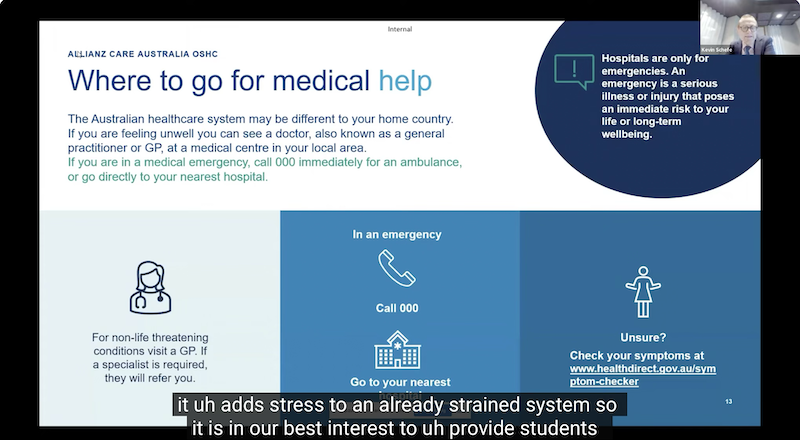
Copyright Essentials for Australian Educators
This webinar explains Australian copyright principles and the Copyright Agency’s statutory education licence. It covers automatic protection, ownership, infringement, attribution and copying limits. Licensed institutions may use text, images and print music educationally, while broadcasts, music, public websites and YouTube require separate consideration. Internal policies and controlled access are recommended.
Learn more about this webinar
This webinar explains Australian copyright for English-language education providers. Copyright arises automatically when original expression is created, protects expression rather than ideas, and generally lasts for the creator’s life plus 70 years. Using a substantial, recognisable part of a protected work may infringe copyright even when the source is available online or attributed. The presenter concentrates on the paid statutory education licence administered by Copyright Agency. Participating institutions may copy and communicate text, images and print music for educational purposes, within limits such as 10 per cent or one chapter. The licence supports classroom handouts, learning-management systems and course packs, but not public websites, marketing materials, broadcasts, audio recordings or YouTube content. Separate licences may cover broadcasts, music, image libraries and subscriptions. The session also distinguishes Australian fair dealing from American fair use, discusses Creative Commons, public-performance exceptions, attribution and permissions, and recommends internal policies, restricted access and copyright responsibility.
AI and Copyright: What Educators Need to Know
This webinar examines generative AI and Australian copyright in education, covering training data, prompts, outputs, licensing and uncertain ownership. Copyright Agency advocates licensing and creator compensation. Providers should restrict third-party content, check platform terms, prevent training on uploaded materials, maintain attribution and records, implement policies and seek advice where necessary.
Learn more about this webinar
This webinar examines how generative AI intersects with Australian copyright law in education. AI training, datasets, user prompts and outputs may involve reproducing protected material, prompting overseas litigation. Copyright Agency argues that creators should be compensated through licensing rather than text-and-data-mining exceptions. For institutions covered by the statutory education licence, third-party material may be entered into AI tools for educational purposes, provided copying limits apply and material is not shared with the developer. However, the value of AI use within that licence remains unresolved. Copyright ownership of AI-generated text and images is uncertain because Australian protection generally requires human authorship; human-developed material refined by AI may be treated differently. Providers are advised to use copyright notices, access controls, internal policies, attribution and development histories. They should carefully examine current platform terms, disable training on submitted content, restrict tools, disclose AI use and obtain advice when ownership or infringement is unclear.

Copyright and Generative AI: Reducing Risk in 2026
This webinar explains how English language providers can manage copyright risks when using generative AI. It covers uploading protected material, AI-generated outputs, permissions, attribution, platform terms and statutory licensing. Providers are encouraged to approve suitable tools, train staff, protect internally developed resources and maintain a clear, regularly reviewed copyright policy.
Learn more about this webinar
This webinar examines how providers can manage copyright risk in AI-assisted resource development and teaching. Copyright Agency explains how protected text and images may be used at three levels: training AI models, refining enterprise systems and uploading through prompts. Examples include using AI to summarise articles, generate quizzes, translate content or adapt teaching resources. The session clarifies misconceptions, including that attribution replaces permission, freely accessible online material is reusable, nonprofit status removes obligations, or Australian education operates under a fair-use exception. Providers are encouraged to understand their licences, review platform terms, control which AI tools staff may use, and check whether uploaded material can be retained for model training. Regular staff development, induction, approved-platform lists and an updated copyright policy are recommended. The webinar also considers ownership of AI-assisted outputs, protection of internally developed materials, available guidance resources and the role of statutory education licensing in supporting compliant educational use.
Inside ASQA: Intelligence, Risk and Provider Self-Assurance
ASQA Director of Intelligence Greg Simmons discusses how data, intelligence and stakeholder information support regulation across vocational and English language education. The webinar examines ELICOS quality, education risks, responsible AI, policy-driven market changes and tip-off management, while encouraging providers to strengthen self-assurance, engage with ASQA and prioritise sustainable educational quality.
Learn more about this webinar
This webinar features a conversation with ASQA Director of Intelligence Greg Simmons about quality, regulatory risk and the role of data in vocational and English language education. Simmons reflects on the importance of ELICOS in supporting international students’ language and cultural transition, while identifying commercial pressure, compressed delivery and premature progression as risks. He explains how ASQA combines data, intelligence, complaints, tip-offs, stakeholder engagement and regulatory activity to understand the sector and respond proportionately. The discussion examines how policy and visa changes can alter provider behaviour, recruitment and sustainability. It also explores responsible artificial intelligence, including transparency, explainability, human accountability, data integrity and its use as decision support rather than automated decision-making. Practical examples show how AI may organise information, identify anomalies and reduce administrative work. The session concludes with guidance on engaging with ASQA, reporting concerns, strengthening self-assurance and maintaining a long-term commitment to educational quality beyond minimum compliance
TPS 2025: Protecting Students When Providers Closer
Representatives from Australia’s Tuition Protection Service and NEAS explain how students are supported when an education provider closes. The webinar covers notification and refund obligations, alternative course placements, protected tuition funds and transparent communication. It emphasises engagement with TPS, accurate records, continuity and each student’s freedom to choose another provider.
Learn more about this webinar
This webinar brings together Australia’s Tuition Protection Service (TPS) and NEAS to explain support for international students when an education provider closes or defaults. The discussion outlines the TPS’s role in arranging refunds, facilitating alternative course placements and helping providers meet their obligations. It covers notification and response timeframes, including notifying the TPS Director and relevant ESOS agency, offering students an appropriate placement or refunding unspent tuition fees, and reporting how obligations were met. A central theme is student choice: learners must be clearly informed that they may accept or reject a proposed transfer and select another provider. The speakers discuss transparent communication, multilingual information, course and unit mapping, provider collaboration, education agents and accurate student records. Additional guidance addresses protected tuition funds and levy arrangements. Providers are encouraged to contact TPS early, plan responsibly and place students’ educational continuity, welfare and informed decision-making at the centre of closure arrangements.
Hosted for Success: Quality and the Future of Homestay in Australia
NEAS discusses Homestay standards, Study NSW partnership and Bonard research, highlighting growth potential, student wellbeing and a proposed national body for high-quality hosted accommodation.
Learn more about this webinar
This webinar examines homestay and hosted accommodation within Australia’s international education sector. NEAS and Study NSW outline national quality standards and an endorsement process designed to strengthen student experiences, host relationships and provider practices. Researchers from BONARD present preliminary findings on the size, structure and future potential of the sector, drawing on interviews with accommodation providers, education agents, institutions and hosts. International comparisons show how Australia’s approach sits between highly regulated systems and more flexible industry led models. The discussion considers homestay as a source of cultural exchange, community connection and additional accommodation capacity for international students. It also explores challenges involving regulation, consistency, awareness, supply and sector coordination. Speakers examine whether a dedicated industry association could provide advocacy, professional development, shared standards, research and a stronger collective voice. Participants are invited to contribute perspectives that can help shape a sustainable, credible, future focused and nationally coordinated hosted accommodation sector.